When Conflict Appears to Recede but Does Not End
If conflict today is sustained rather than resolved, and conducted through simultaneous pressure and negotiation, the question is how it is perceived when it appears to slow down.
At times, this recalibration may take the form of visible escalation rather than restraint.
In modern conflict, de-escalation is no longer a clear or definitive phase. It is increasingly a moment of adjustment rather than resolution. What appears as a reduction in intensity often reflects a shift in tactics, a recalibration of pressure, or a temporary reduction in visibility rather than a meaningful step toward stability.
This results in a condition in which conflict does not disappear. It changes form.
Recent developments across multiple regions illustrate this pattern. Periods of reduced headlines, moderated rhetoric, or limited pauses in direct confrontation are often interpreted as signs of easing tension. Yet beneath this surface, military postures remain intact, strategic objectives unchanged, and the capacity for escalation preserved. What is visible suggests calm. What exists beneath it does not.
This disconnect between perception and reality lies at the core of the illusion.
De-escalation, in its traditional sense, implied a movement toward resolution. It suggested a reduction in hostility, a narrowing of objectives, and the possibility of disengagement. In the current environment, it increasingly functions differently. It signals control rather than closure, management rather than settlement.
States adjust intensity without abandoning intent.
This shift is shaped by the structure of modern conflict. Direct escalation carries high and often unpredictable costs. At the same time, disengagement can signal weakness or concede strategic ground. The result is a preference for operating within a controlled range, where pressure is maintained but thresholds are not crossed.
Within this space, de-escalation becomes a tool rather than an outcome.
It allows states to stabilise situations temporarily, manage external interpretation, and avoid uncontrolled escalation without fundamentally altering the trajectory of conflict. Actions are calibrated. Signals are moderated. Yet the underlying dynamics remain unchanged.
This is not de-escalation as resolution. It is de-escalation as regulation.
The persistence of parallel negotiation reinforces this dynamic. Dialogue continues even as confrontation does. Communication provides flexibility, while pressure maintains leverage. Together, they create a system in which conflict is neither fully intensified nor fully reduced.
This creates a form of equilibrium, but one that is inherently unstable.
Perception plays a critical role in sustaining this condition. Public interpretation often relies on visibility. Fewer visible incidents, reduced rhetoric, or diplomatic engagement are taken as indicators of improvement. Markets respond to signals of stability. Political narratives emphasise restraint. The absence of immediate escalation is read as progress.
However, the absence of escalation is not the presence of peace.
This distinction is often overlooked. Conflict can persist at lower levels of intensity without moving toward resolution. It can remain active, structured, and consequential even when it is less visible.
This creates the illusion of de-escalation.
The illusion is not necessarily constructed through deliberate misrepresentation. It emerges from the way modern conflict is conducted and communicated. Visibility fluctuates. Intensity shifts. Narratives emphasise control. Together, these elements produce a perception of stability that may not correspond to underlying reality.
This effect is further shaped by how conflict is presented and interpreted in real time. Information flows, public briefings, and institutional communication increasingly influence not just awareness, but expectation. Periods of reduced visibility often coincide with narratives of stabilisation, even when underlying positions remain unchanged. The interpretation of events begins to diverge from their structural reality.
Strategic messaging plays a central role in this process. Statements emphasising restraint, calls for stability, and coordinated communication from international groupings are designed to signal control and prevent escalation. These signals are essential for maintaining confidence across political and economic domains. At the same time, they can create an impression of easing tension, even when engagement continues beneath the surface.
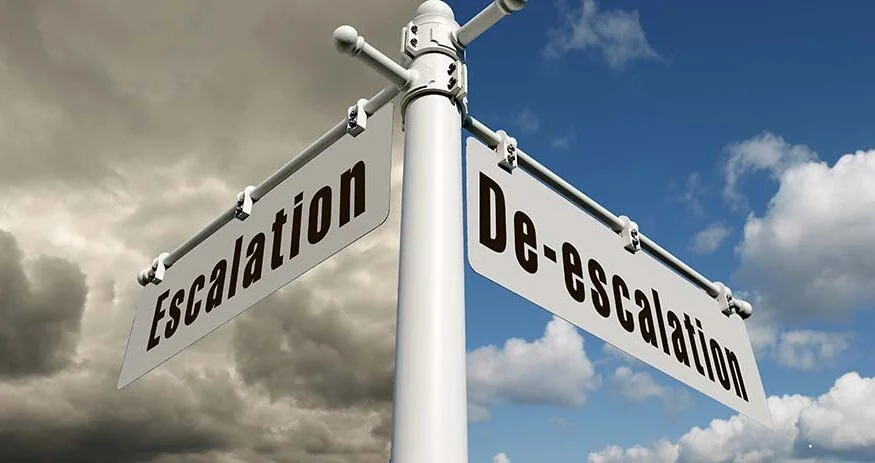
This introduces a distinction between signalling and trajectory. What is communicated publicly may reflect intent to manage perception, while actual strategic direction remains unchanged. The appearance of stability, in such cases, is not an outcome but a projection.
Strategic pauses reinforce this dynamic. Temporary reductions in visible activity are often interpreted as movement toward disengagement. In practice, they frequently serve as intervals for reassessment, repositioning, and recalibration. Capabilities are preserved, objectives remain intact, and the option of renewed escalation is retained. What appears as a pause may instead be a transition.
Time, in this context, becomes an operational variable. Slowing the pace of visible activity can reduce pressure, reshape perception, and create diplomatic space without altering the underlying structure of conflict. The external tempo changes. The internal trajectory does not.
This has direct implications for how risk is understood. When visible intensity declines, the perception of threat often declines with it. Attention shifts, urgency dissipates, and stability is assumed. Yet the conditions that produced conflict may remain firmly in place.
The consequence is not misrepresentation, but misinterpretation.
When calm is read as resolution, preparedness can weaken. Strategic assessments may shift prematurely, and responses may be calibrated to a reality that has not fundamentally changed. The risks that follow are not immediate, but they are cumulative.
This pattern extends beyond active participants. Observers, markets, and institutions all respond to signals of stability. Decisions are made, positions adjusted, and expectations reset based on what appears to be a de-escalating environment. When that perception diverges from reality, the effects can be widespread.
The challenge, therefore, is not only to manage conflict, but to read it accurately. Stability must be assessed not by the absence of visible tension, but by the presence or absence of structural change.
Systems further reinforce this perception. Economic markets stabilise after initial shocks. Supply chains adjust to new conditions. Institutions frame developments in terms of management rather than crisis. Over time, disruption becomes familiar, and familiarity is interpreted as normalisation.
Yet normalisation does not imply resolution.
It indicates adaptation.
This adaptation allows conflict to persist within systems without triggering constant alarm. It reduces urgency, diffuses attention, and creates space for sustained engagement without decisive outcomes. The extraordinary becomes routine, and the routine obscures the persistence of underlying tension.
The illusion of de-escalation is therefore not a temporary misreading. It is a structural feature of how modern conflict is experienced.
This has important implications for strategy. If de-escalation is interpreted as resolution, responses may become premature or insufficient. If stability is assumed where it does not exist, preparedness may weaken. Understanding the difference between reduced visibility and reduced risk becomes essential.
For countries like India, this distinction carries particular significance. Operating within an interconnected environment, India is affected not only by escalation but also by its perception. Signals of stability influence markets, policy choices, and strategic positioning. At the same time, underlying risks continue to shape long-term planning.
This requires a careful reading of both action and perception.
India’s approach reflects this balance. Engagement across multiple actors, maintenance of communication channels, and calibrated responses allow it to navigate an environment where conflict is neither fully visible nor fully resolved. Strategic autonomy, in this context, is not simply a matter of positioning. It is a method of managing uncertainty.
This environment also intersects with familiar patterns closer to home. In South Asia, particularly in the context of Pakistan, periods of apparent calm have often coexisted with persistent underlying tensions. Reduced visibility has not always translated into reduced intent. This reinforces the importance of distinguishing between surface stability and structural continuity.
At a broader level, the illusion of de-escalation challenges how conflict is understood. It suggests that stability may no longer be a clear endpoint, but a managed condition within ongoing tension. It blurs the line between war and peace, replacing clear transitions with gradual shifts.
In such a landscape, conflict does not need to intensify to remain consequential. It only needs to persist.
Understanding this requires a shift in perspective. The focus must move from visible events to underlying structures, from immediate signals to sustained patterns, and from moments of calm to the continuity that lies beneath them.
De-escalation, therefore, must be interpreted with caution. It may indicate restraint, but it does not necessarily lead to resolution.
In modern conflict, what appears to be a step back may simply be a repositioning.
And what looks like stability may, in fact, be the system learning how to sustain tension more effectively.
De-escalation today is not the end of conflict. It is often how conflict continues.
Dr. Gaurav Vaid
Freelance Writer & Analyst
gauravvaid2010@gmail.com
Source: https://greaterjammu.com/epaper/epaper/edition/918/epaper-1-4-2026/page/6