When administration changed its script, a civilization lost one of its mirrors.
Scripts do not disappear when languages weaken. They disappear when power shifts, policy recalibrates, and printing presses choose convenience over continuity. The story of Takri, once the working script of the Dogra and Western Himalayan belt, is not merely a linguistic footnote. It is a layered narrative of administration, empire, reform, identity, and strategic modernization. It is about how culture is not only preserved by pride but also governed by policy. It is also about how decisions taken in courts, secretariats, and classrooms by specific rulers and administrations reshape what future generations are able to read about their own past.
Takri did not vanish in silence. It was gradually edged out; first by imperial hierarchy, then by bureaucratic reform, then by educational standardization, and finally by technological exclusion. Its decline was not accidental; it was structural and policy driven across successive regimes and rulers.
And yet, the emotional truth of Dogri identity still echoes in lines people continue to recite:
हिंदी साढ़ी दादी, ते डोगरी साढ़ी माँ
दादी थार दादी, ते माँ थार माँ
A grandmother may be loved but mother is mother. That distinction captures the cultural place of Dogri, and once, of Takri in the lived world of the region.
Takri did not emerge in isolation. It belongs to the great Brahmic script family. Its nearer ancestor was Sharada, the script widely used between roughly the 8th and 12th centuries across Kashmir and adjoining Himalayan regions for Sanskrit scholarship, temple inscriptions, and manuscripts. Sharada was formal, angular, and suited to learned writing. From Sharada evolved faster regional cursive hands across the hills, shaped by the needs of scribes who wrote for revenue offices rather than monasteries.
But administration does not run on manuscript elegance. It runs on speed.
As hill states expanded their revenue systems and local governance structures between the 13th and 15th centuries, scribes developed faster, more cursive writing styles derived from Sharada. Over time, these functional hands stabilized into what we now call Takri; though in reality it was not one script but a family of regional variants: Jammu Takri, Chamba Takri, Kangra Takri, and others. Takri was built for use, not display. It was the script of land, tax, grain, boundaries, inheritance, and accounts. It wrote property and obligation, the grammar of everyday statecraft. For Dogri and several Western Pahari languages, Takri became the practical written vehicle. It was not sacred. It was not imperial. It was working. That distinction matters.
During the long Mughal and post-Mughal centuries under emperors such as Akbar and his successors, Persian functioned as the language and script of high administration across much of North India. Even in hill regions, Persian held elite authority in diplomacy, higher courts, and imperial correspondence. This produced a layered script order. Persian ruled the top tier; Takri handled the ground tier. Takri survived comfortably, but without prestige insulation. Scripts tied to empire or religion acquire institutional armour. Scripts tied to local administration remain vulnerable to reform. Takri was efficient but institutionally exposed.
The mid-19th century marked a decisive political consolidation of the region under Dogra rule beginning with Maharaja Gulab Singh. With state expansion came administrative deepening; more records, more courts, more taxation structure, more legal procedure. Takri continued as the working script in revenue and local offices during his period, but pressures were building that would reshape the script ecosystem as the state moved toward codified governance and centralized control.
Modern states prefer uniform systems. Diversity in script is culturally rich but bureaucratically expensive. As governance grows more formal, the demand for standardization grows with it.
The late 19th century reform phase under Maharaja Ranbir Singh marked the critical turning point. His reign saw legal codification, compilation of state laws, institutional restructuring, and growth of formal courts. Administration was no longer only handwritten and local; it was increasingly printed and system-wide. Printing changes everything. Printing requires fonts, typesets, compositors, training, and distribution networks. Takri had almost none of this infrastructure. Devanagari already had it along with a wider literary ecosystem linked to Sanskrit and emerging Hindi print culture. Policy followed practicality. Devanagari began receiving formal encouragement in administration and legal documentation during this reformist phase.
That policy momentum strengthened further under Maharaja Pratap Singh. Bureaucratic training, schooling, and printed material increasingly used Devanagari. Courts and revenue offices changed formats and record templates. Clerk recruitment standards gradually aligned with Devanagari literacy. Once job qualification standards change, script literacy follows. This is how scripts decline; not by ban, but by bypass. Takri was not prohibited by proclamation. It was made professionally unnecessary.
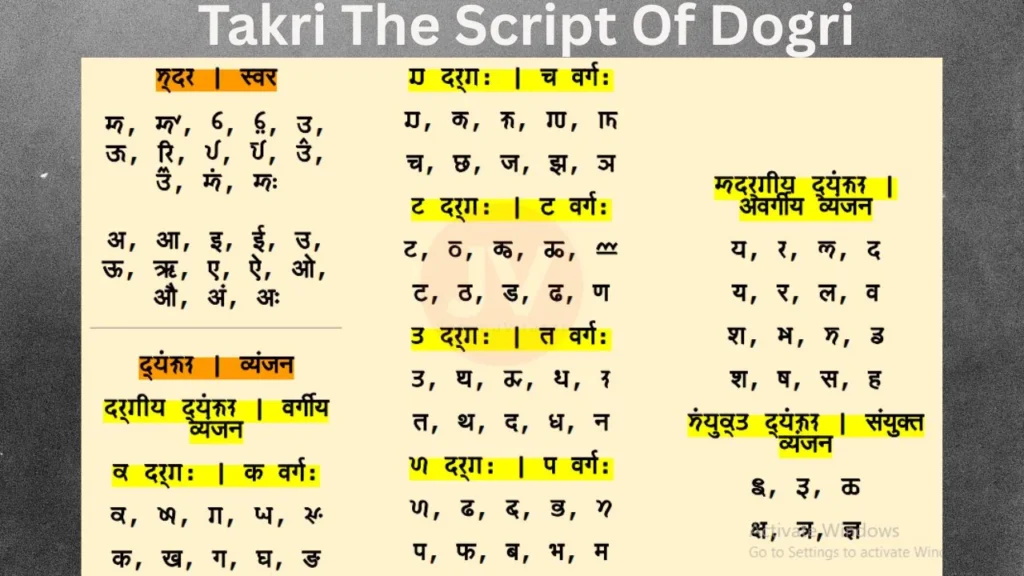
From a governance perspective, the move toward Devanagari made administrative sense:
- One script is easier to standardize than many
- Print-ready scripts scale faster
- Training pipelines become simpler
- Legal uniformity improves
- Record duplication reduces error
But from a cultural continuity perspective, something irreplaceable was lost, a regional written identity embedded in everyday life and local memory systems. Modernization is rarely neutral. It optimizes and in optimizing, it selects. Takri was not defeated by argument. It was defeated by efficiency backed by state preference.
The decisive blow to Takri came not from courts but from classrooms. When schools stop teaching a script, its future collapses within two generations. As educational curricula shifted toward Devanagari literacy through late Dogra period schooling policies, Takri ceased to reproduce readers. Without readers, there are no writers. Without writers, there is no print demand. Without print, there is no revival loop. Script death is demographic before it is symbolic. By the early 20th century, Takri literacy had sharply contracted to older scribal circles and legacy record keepers.
During the reign of Maharaja Hari Singh, regional language consciousness including Dogri gained cultural visibility and literary energy. Yet even in this culturally receptive phase, the script question had already been decided by infrastructure. When organized literary activism took shape through Dogri Sanstha, Jammu founded in 1944, a strategic decision was made to promote Dogri through Devanagari rather than attempt full Takri restoration. This was tactical realism. Printing presses, textbooks, and readers already existed in Devanagari. Takri had none at scale. Language survival was prioritized over script recovery. The choice worked for Dogri literature, but it finalized Takri’s displacement from living use.
Comparative script history shows a pattern: scripts anchored to sacred canon or strong institutional ritual survive transitions better. History offers a revealing contrast here. In the 16th century, Guru Angad Dev Ji standardized and propagated the Gurmukhi script, transforming a regional writing form into a disciplined, teachable, community script. He did not merely refine letter shapes; he built a literacy movement around it. By making script learning part of spiritual and social practice, he ensured that Gurmukhi would be reproduced across generations. Later, when Sikh scripture was compiled in that script, its continuity became inseparable from faith and identity. Script then gained sanctuary beyond state policy. Takri never received such civilizational anchoring. It remained tied to revenue desks and record rooms, not to liturgy, pedagogy, or collective ritual. When administrative patronage shifted away, there was no parallel moral or institutional force strong enough to carry it forward.
Takri did not have that anchor. It was tied to paperwork, not prayer. When administrative patronage withdrew, nothing equally strong replaced it. After Independence, language policy across India often favoured script consolidation for educational and administrative scalability. Regional scripts without institutional ecosystems steadily declined unless protected by strong literary or religious movements.
Dogri eventually achieved constitutional recognition in 2003, but in Devanagari script rather than Takri. Recognition followed usage, not heritage.
And yet identity does not live in policy documents alone. It lives in sound, memory, and shared speech. Dogri’s cultural self image continues to be expressed in oral pride:
डोगरें दी मिट्ठी बोली
ते खंड मिठे लोग डोगरे
Takri today is not dead; it is archival. It exists in manuscripts, land records, scholarly projects, digital encoding standards, and heritage revival efforts. But revival is not restoration. A script removed from administration, schooling, and mass print cannot easily return to everyday use. Scripts live where power writes, where schools teach, and where presses print. Takri’s story is not about blame. It is about understanding how modernization under rulers from Gulab Singh to Hari Singh reorganized the written order of a region. Administrative efficiency, legal standardization, print scalability, and educational uniformity built a stronger state, but narrowed script diversity.
There is also a contemporary policy lesson here. Heritage preservation cannot remain limited to monuments and folklore while written traditions are left to decay in archives. Scripts are knowledge technologies. They carry legal memory, social contracts, land relations, poetry, and local epistemology in their original form. When scripts disappear from public literacy, access to primary sources narrows and interpretation becomes dependent on intermediaries. That creates distance between a people and their own documentary past. Takri records still exist across private collections and revenue archives, but direct reading literacy in the script has nearly disappeared. Preservation therefore must move beyond sentiment toward structured action through curriculum modules, archival digitization, script courses, and visible cultural signage. A civilization that can no longer read its own records without translation has already ceded part of its intellectual sovereignty.
Takri lost power before it lost relevance. Once power moved, relevance could not carry it alone. Preserving Takri now is not about reversing history. It is about completing memory and ensuring that future generations can read what their past actually wrote. Languages speak through people, but civilizations remember themselves through scripts.
Dr. Gaurav Vaid
Freelance Writer & Analyst
gauravvaid2010@gmail.com
Source: https://greaterjammu.com/epaper/epaper/edition/864/epaper-8-2-2026/page/6