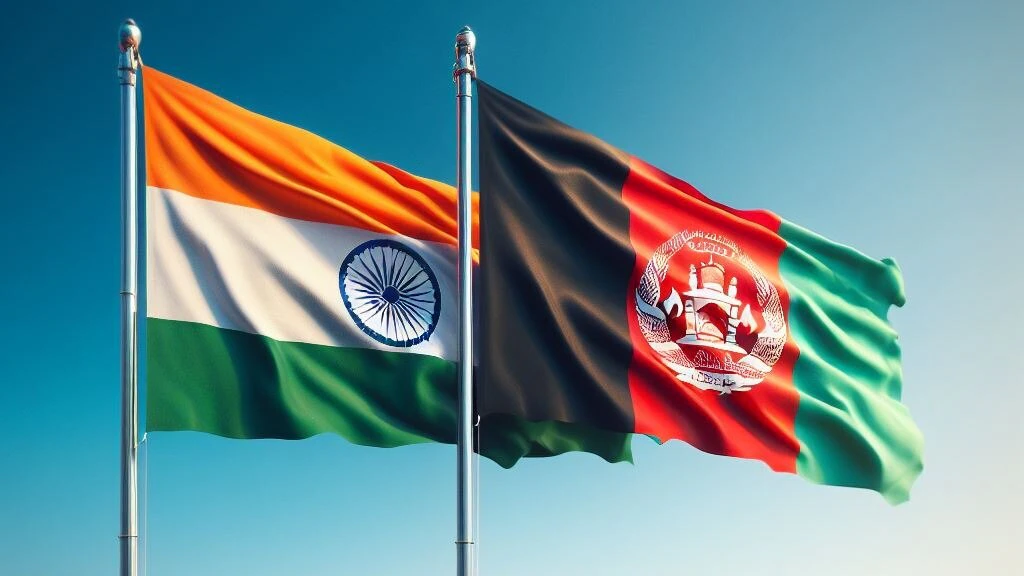
Across millennia, the story of India and Afghanistan has never been merely a tale of borders; it has been a narrative of bridges — of ideas, languages, and people crossing mountains long before politics built walls. From the Gandhara civilisation to Khan Abdul Ghaffar Khan’s Khudai Khidmatgar, and from the Salma Dam to the embassy lights flickering again in Kabul, the Indo–Afghan relationship has evolved through conquest and cooperation, collapse and renewal, yet has always carried a thread of shared destiny.
Centuries before “India” and “Afghanistan” were drawn on maps, they were part of one civilisational continuum. The Gandhara civilisation, straddling today’s Peshawar and Kandahar, fused Greek artistry with Buddhist spirituality. From here, Buddhism travelled north to Central Asia, carrying Sanskrit texts and Indian philosophy along the Silk Road. Afghan valleys became the first corridors of Indian culture; Indian plains became the first markets for Afghan traders. Even as empires rose and fell — from Mauryas to Kushans — the region remained a living conversation between two worlds. The Bamiyan Buddhas stood as their stone witnesses until intolerance tried to erase memory itself.
Through the medieval period, the connection was not of geography alone but of lineage. Afghan rulers such as the Lodhis and the Surs shaped Delhi’s destiny; Babur launched his Mughal dream from Kabul, calling the city the garden of his heart. For centuries, Kabul was a crossroads rather than a frontier. Caravans carried not just goods but words; Persian poetry, Hindustani rhythms, and shared idioms of faith. The mountains divided terrain, never imagination.
The British Empire changed everything. The Durand Line of 1893 sliced through Pashtun lands, turning kin into foreigners. Afghanistan became the “buffer state” in the Great Game between London and St Petersburg. Yet, even in this era of manipulation, moral kinship survived; embodied in Khan Abdul Ghaffar Khan, the “Frontier Gandhi.” Born in Utmanzai, he led the Khudai Khidmatgar (Servants of God), a non-violent Pashtun movement inspired by Mahatma Gandhi’s creed of truth and ahimsa. Ghaffar Khan fought for Hindu–Muslim unity and opposed Partition, declaring that the British had “thrown us to the wolves.” His friendship with Gandhi and Nehru turned the North-West Frontier into a moral frontier of peace. Even after Independence, his legacy remained a bridge: Afghanistan was the only nation to oppose Pakistan’s admission to the UN in 1947, citing the unresolved Pashtun question, an act of symbolic solidarity with India.
Post-1947, India and Afghanistan built a partnership grounded in non-alignment. Both nations shared suspicion of military blocs and a desire for strategic autonomy. India opened one of its first embassies in Kabul; Afghan students filled Indian universities; Bollywood films and Hindustani songs reached Herat and Kandahar long before diplomats did. During the Cold War, as Kabul gravitated toward Moscow, India maintained friendly neutrality, supporting development without dictating politics. When King Zahir Shah was deposed and President Daoud Khan sought modernisation, India remained an economic and educational partner, not an intrusive power.
When the Soviet invasion of 1979 transformed Afghanistan into a Cold War battleground, India refused to join the Western–Pakistani axis arming the Mujahideen. It condemned violence but continued humanitarian assistance. Pakistan, meanwhile, became the conduit for American weapons and Saudi ideology, birthing a militant infrastructure that would later destabilise the region. Afghanistan’s tragedy became Pakistan’s temporary leverage. India’s caution then was often misunderstood, but it preserved goodwill among ordinary Afghans who distinguished between politics and compassion.
The 1990s saw the collapse of the Najibullah government and the rise of the Taliban regime (1996–2001), backed by Pakistan’s ISI. For India, this was both moral and strategic isolation. The Taliban’s hostility, its harbouring of anti-India militants, and the Kandahar hijacking of 1999 closed the door to diplomacy. India supported the Northern Alliance under Ahmad Shah Massoud but avoided direct intervention. Afghanistan became a symbol of Pakistan’s proxy triumph — a triumph now turning against its creator.
The post-9/11 U.S. intervention opened Afghanistan once more to the world, and India returned not with troops but with tools of reconstruction. In two decades, India invested over $3 billion in nation-building: the Salma Dam in Herat, rechristened the Afghan-India Friendship Dam; the Afghan Parliament building, a gift from Indian democracy to Afghan democracy; and the Zaranj–Delaram Highway, connecting Afghanistan to Iran’s Chabahar Port and bypassing Pakistan. Thousands of Afghan officers, engineers, and students trained in Indian institutions. Bollywood bridged where politics hesitated. No other foreign partner enjoyed such affection among Afghans. India’s strength lay in soft power — development without deployment.
The Taliban’s return in August 2021 ended that golden chapter, but India’s engagement never vanished. While Western embassies fled, India sent wheat, vaccines, and medicine. A technical mission reopened in 2022, keeping channels alive. By 2024, as Pakistan’s influence over the Taliban frayed and China, Iran, and Russia courted Kabul, India began exploring cautious re-entry. Then, in October 2025, came the defining moment: Taliban Foreign Minister Amir Khan Muttaqi visited New Delhi, and India announced that it would upgrade its Kabul mission to a full embassy; a signal of pragmatic engagement, not political recognition.
Barely hours after that diplomatic handshake, the border ignited. Pakistan launched air and drone strikes on Kabul and Paktika, claiming to target TTP militants. Afghanistan denounced the strikes as aggression and, within a day, Taliban border forces struck back, attacking Pakistani military posts along the Durand Line. For the first time in years, Afghan and Pakistani troops faced each other in open battle, trading control of frontier posts; a modern echo of an old imperial wound. While Kabul’s envoy was discussing cooperation in Delhi, Islamabad was opening a war front; an irony that captured the new geometry of South Asia: Afghanistan defying Pakistan, and India quietly re-entering the scene.
As this frontier burned, another theatre flickered toward calm: in the Levant, a U.S.-brokered ceasefire was taking hold in Gaza. President Donald Trump flew to Israel to mark the truce and address the Knesset before co-hosting a peace summit in Egypt, framing the moment as the end of the Gaza war and the start of a wider regional normalisation. The juxtaposition was stark; diplomacy in the west, detonation in the east, and a reminder that Middle Eastern and South Asian crises rarely move in isolation. It would be naïve to imagine Washington was oblivious to the rising heat on the Durand Line while shepherding a truce in Gaza. U.S. and allied services track the Pak–Afghan frontier constantly; whether they foresaw the exact tempo of escalation is unclear, but awareness and concern are not in doubt. What is clear is that the United States chose to prioritise the Gaza ceasefire optics even as a new front risked opening further east; a diplomatic choreography India must read with care.
For New Delhi, this turbulence is both risk and opening. Re-engagement with Kabul offers access, intelligence, and influence at a moment when Pakistan’s hold weakens and China advances. Yet it also demands restraint. India cannot legitimise the Taliban’s internal repression, but neither can it ignore a neighbour that shares a sixty-year memory of friendship. Hence the doctrine: engagement without endorsement. Reopen the embassy, deliver aid, reopen classrooms — but draw firm red lines against terror sanctuaries and human-rights violations. Maintain humanitarian leadership while defending national security.
In parallel, the Chabahar Port remains India’s strategic lifeline to Afghanistan and Central Asia. Even after Washington revoked sanctions waivers in 2025, New Delhi continues to pursue limited humanitarian corridors through Iran. Each convoy of Indian wheat reaching Afghan soil without crossing Pakistan is a quiet assertion of sovereignty; proof that influence can travel where armies do not.
Amid today’s volatility, the vision of Ghaffar Khan glows brighter. His creed of non-violence and fraternity across faiths stands in stark contrast to the extremism that consumes the region. He imagined a South Asia bound not by barbed wire but by moral imagination; an India and Afghanistan joined by compassion rather than conquest. If Gandhi taught India that non-violence could liberate the colonised, Ghaffar Khan taught Afghanistan that dignity could exist without domination. Their friendship remains the spiritual foundation on which diplomacy can still stand.
Pakistan’s insecurity has turned into open hostility; Afghanistan’s assertion of sovereignty has become a firefight; India’s caution has turned into cautious confidence. The region is once again writing its history in both ink and fire. Meanwhile, in the Mediterranean’s shadow, the ceasefire in Gaza; fragile, conditional, and politically charged, offers a glimpse of de-escalation even as a new front opens on South Asia’s rim. For Indian statecraft, the lesson is simple: every theatre talks to another, and timing is as strategic as territory.
For India, the task is to hold steady; to remember that real power in South Asia is measured not in airstrikes or alliances, but in how long a nation can keep faith when others lose it. The structures India raised in Afghanistan — schools, dams, hospitals — were never monuments to policy but to persistence. When the embassy lights glow once more in Kabul, they will not only signal the return of diplomats but the endurance of a relationship that has weathered every storm. From the ashes of wars and partitions to the promise of dialogue, the Indo–Afghan bond endures; not through force, but through faith in a shared future.