Nations move first when the ground beneath them begins to shift
In geopolitics, movement itself is often a message.
When national leaders begin travelling with unusual frequency across strategic corridors, from Europe to West Asia, from maritime powers to technology economies, observers naturally focus on the visible outcomes: trade agreements, joint statements, defence cooperation, investment promises, and increasingly, viral photographs. Yet diplomacy also operates in quieter ways. Sometimes the significance lies less in what is publicly announced and more in what is gradually being assembled beneath the surface.
Prime Minister Narendra Modi’s recent diplomatic engagements across Europe and the Gulf come at a moment when the international system appears deeply unsettled. The global order is no longer defined by a single dominant conflict or ideological divide. Instead, multiple fault lines are widening simultaneously through economic fragmentation, technological rivalry, maritime competition, supply-chain insecurity, energy vulnerability, ideological polarization, and regional instability. In such an environment, nations do not merely react to events. They prepare for possibilities, and that preparation is rarely dramatic. It is gradual, layered, and often disguised as routine diplomacy.
Across the last decade, India’s foreign policy has evolved from reactive regional management toward broader geopolitical positioning. What appears today is not simply an expansion of bilateral relations, but the construction of diplomatic depth across multiple theatres at the same time. Europe, the Gulf, the Indo-Pacific, and emerging connectivity corridors are increasingly being linked within a larger strategic framework.
The timing matters because South Asia itself is passing through a sensitive phase of transition. Bangladesh continues navigating political uncertainty. Pakistan remains economically fragile and internally volatile. Myanmar is unstable. The Indian Ocean is becoming increasingly contested. China continues expanding influence through infrastructure, ports, technology, and maritime presence. At the same time, the wars in Ukraine and Gaza have reshaped assumptions about sanctions, energy security, supply chains, and the weaponization of economics itself. Under such conditions, connectivity acquires strategic meaning. Ports become more than ports. Technology agreements become more than commerce. Energy partnerships become instruments of resilience. Diplomatic visits become signals of alignment without formal alliances.
This is perhaps why initiatives like the India-Middle East-Europe Economic Corridor matter beyond economics alone. Corridors shape geography politically as much as commercially. They define future routes of influence, dependency, and strategic access. In an age where trade, data, energy, infrastructure, and security increasingly overlap, connectivity itself becomes geopolitical architecture.
India appears acutely aware of this transition. Yet within the country, these diplomatic movements are not being interpreted uniformly.
Criticism has intensified from sections of the opposition and parts of the public who view the Prime Minister’s extensive travel through a different lens. The criticism is not entirely about diplomacy itself. Rather, it emerges from the contrast between external outreach and internal economic caution. During periods of inflationary pressure, energy volatility, and global uncertainty, citizens are repeatedly urged to exercise restraint, conserve resources, prioritize stability, and adapt to economic pressure. Rising fuel prices, employment anxieties, costlier imports, and uneven recovery after successive global disruptions have placed visible strain on households across India.
Against this backdrop, images of high-profile international visits, large delegations, ceremonial receptions, and carefully choreographed diplomacy naturally generate political debate. Opposition voices ask a simple question: if ordinary citizens are being told to prepare for economic uncertainty and tighten spending, why does the government appear to be accelerating global engagement instead of consolidating inwardly?
The criticism is politically understandable. Geopolitically, however, the answer may be more complicated.
Historically, periods of instability are precisely when states intensify diplomacy rather than reduce it. During uncertain transitions, external engagement becomes a tool for insulating domestic economies from future shocks. Leaders travel not only for symbolism, but to secure energy partnerships, technology access, investment channels, manufacturing cooperation, maritime routes, and supply-chain reliability before disruptions deepen. Diplomacy, in such moments, becomes a form of preventive economics.
When a Prime Minister visits energy-producing nations during volatile oil markets, the visit is no longer merely ceremonial. When semiconductor cooperation, AI partnerships, digital infrastructure, shipping corridors, maritime security, and critical minerals dominate bilateral discussions, these are no longer isolated sectors of development policy. They increasingly form part of national resilience planning.
The modern battlefield is no longer confined to geography alone. It now includes chips, cables, ports, data, energy routes, logistics systems, and financial networks.
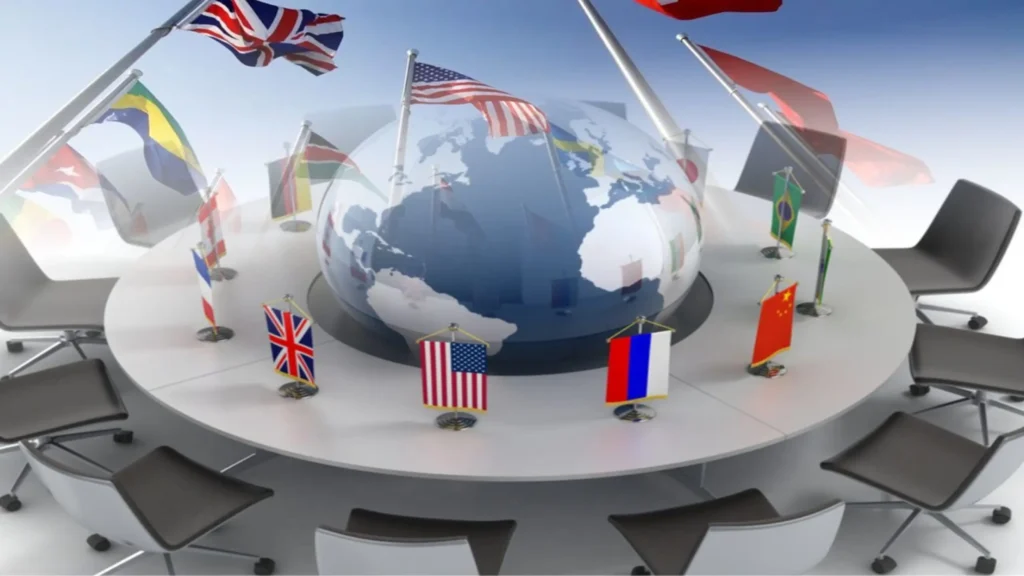
The COVID era, the Ukraine war, and the sanctions regimes that followed fundamentally altered how states think about vulnerability. Nations discovered how quickly supply chains could fracture, trade routes could collapse, medicines could become inaccessible, and energy prices could destabilize entire economies. Strategic dependence suddenly became visible. India, like many rising powers, appears to be responding to that lesson.
This helps explain the convergence around certain themes during recent diplomatic engagements: logistics, maritime security, manufacturing relocation, AI governance, technology partnerships, digital regulation, critical minerals, and energy cooperation. Seen through that lens, Modi’s travels represent less a sequence of isolated state visits and more an effort to widen India’s geopolitical room in a rapidly hardening international environment.
Another important dimension is India’s evolving doctrine of strategic autonomy. New Delhi today occupies a delicate position. It is deepening engagement with Europe and the United States while simultaneously remaining active within BRICS, maintaining relations with Russia, strengthening ties with Gulf monarchies, and presenting itself as a leading voice of the Global South. This balancing approach is neither accidental nor easy. India appears determined to avoid becoming fully absorbed into any single geopolitical bloc. Instead, it seeks flexibility through multi-alignment while preserving independent decision-making. In an increasingly polarized environment, diplomatic flexibility itself becomes a source of influence.
This explains why India often appears simultaneously close to competing actors. To some observers, this creates contradictions. To strategists, it creates leverage.
The symbolism surrounding recent visits, including the widely circulated interactions between Modi and Giorgia Meloni, should also not be dismissed merely as social-media spectacle. Modern diplomacy increasingly functions through perception as much as policy. Images build familiarity, normalize partnerships, and create narratives that travel globally at digital speed. Earlier eras relied on closed-door negotiations and carefully worded communiqués. Today, diplomacy unfolds publicly through photographs, videos, hashtags, and narrative projection. The widely discussed “Melodi” phenomenon reflects more than internet humour. It demonstrates how political imagery can humanize strategic relationships for domestic and international audiences alike.
Yet optics alone cannot explain the scale and frequency of recent outreach. A deeper interpretation is that India senses the international system entering a prolonged period of transition marked by fragmented alliances, economic weaponization, technological rivalry, cyber vulnerability, regional instability, and strategic uncertainty. The assumptions that once defined globalization are weakening. Countries increasingly speak the language of trusted supply chains, digital sovereignty, strategic minerals, economic security, and friend-shoring. Trade itself is being securitized. Technology partnerships now carry defence implications. Even infrastructure projects are interpreted through geopolitical lenses. Under such conditions, diplomacy becomes less about idealism and more about preparedness.
This does not necessarily mean India anticipates imminent conflict. Geopolitics is not prophecy. But mature states often strengthen networks before instability becomes fully visible. History repeatedly shows that geopolitical earthquakes are preceded by subtle diplomatic movement. Before wars appear openly on maps, they often emerge first through alignments, logistics agreements, corridors, military exercises, energy partnerships, and strategic signalling. The architecture of future crises is frequently constructed quietly during periods officially described as peace. From this perspective, India’s current diplomatic tempo begins to look less reactive and more anticipatory.
At the same time, domestic criticism cannot simply be dismissed as political noise. Democracies function through scrutiny. Citizens facing inflation, unemployment, rising living costs, or economic pressure naturally question state priorities. Foreign policy cannot remain entirely insulated from domestic perception.
There is also a deeper psychological contrast at play. For ordinary citizens, sacrifice is personal. For states, preparation is strategic. When governments speak of restraint while simultaneously projecting confidence abroad, tension emerges between the emotional economy of the public and the long-term calculations of the state. Managing that contradiction requires transparency, credibility, and public trust.
This may become one of the defining political challenges for governments globally in the coming decade: how to prepare societies for instability without generating panic, and how to pursue geopolitical positioning while domestic populations remain economically anxious.
India is not alone in facing this dilemma. Across the world, states are attempting to secure energy, technology, maritime influence, trade access, and supply-chain resilience while simultaneously managing domestic polarization and economic fatigue. The age of easy globalization appears to be fading into an era of guarded interdependence.
Perhaps this is the deeper significance of the present diplomatic moment.
These journeys may not simply be about ceremonial visibility or electoral projection. Nor are they necessarily evidence of imminent crisis. Rather, they may reflect the behaviour of a state attempting to widen its options before the contours of the next global disruption fully emerge.
Sometimes nations travel more because the world itself is moving beneath them.
In periods of global transition, governments are often forced to prepare for risks that may not yet be fully visible to the public. Citizens naturally judge policies through the pressures of everyday life, while states increasingly calculate through the lens of long-term resilience, security, and survival. The tension between those two realities is real, and democracies will continue debating it intensely.
But history rarely remembers political arguments during crises. It remembers whether nations were prepared.
Dr. Gaurav Vaid
Freelance Writer & Analyst
gauravvaid2010@gmail.com
Source: https://greaterjammu.com/epaper/epaper/edition/974/epaper22-5-2026/page/6