What we see globally is no longer what is actually happening
The world is entering one of the most confusing geopolitical transitions in modern history. Yet unlike earlier eras of transformation, this shift is not arriving through one defining event alone. There is no single wall falling, no formal declaration of a new Cold War, and no universally acknowledged turning point. Instead, the global order is changing quietly, unevenly, and often invisibly beneath the surface of everyday headlines. What people see publicly and what states are preparing privately are increasingly becoming two different realities.
Diplomatic meetings continue. Leaders shake hands. Trade forums operate normally. Financial markets fluctuate but survive. Tourism continues. Technology expands. Social media creates the impression of a permanently connected world. And yet underneath that appearance of continuity, nations are recalibrating at remarkable speed. The United States confronts China strategically while remaining economically dependent on Chinese manufacturing and supply chains. China publicly speaks of cooperation while accelerating military modernization and preparing for prolonged geopolitical rivalry. Europe talks about strategic stability while quietly strengthening defence preparedness. Gulf states simultaneously deepen ties with Washington, Beijing, Moscow, and emerging Asian economies. India maintains relations across multiple competing blocs because rigid alignment itself has become risky.
Even rivals no longer behave like traditional rivals. Countries cooperate economically while competing technologically, negotiate publicly while preparing contingencies privately, and condemn escalation while increasing defence budgets. The old geopolitical script no longer fully explains the world because the assumptions that shaped the post-Cold War order are weakening rapidly. For decades, economic integration was expected to reduce geopolitical confrontation. Trade was meant to create interdependence, globalization was expected to make conflict economically irrational, and international institutions were supposed to manage instability before it spiralled. That confidence has weakened dramatically over the last few years.
Ukraine exposed the return of prolonged industrial warfare in Europe. Iran and the Gulf revealed how quickly energy routes can destabilize global markets. Taiwan now shadows every major interaction between Washington and Beijing because the future of semiconductors, artificial intelligence, manufacturing, and military balance increasingly converges there. Artificial intelligence itself has introduced a new form of geopolitical competition where technological dominance may become as strategically important as military power. Economics, security, diplomacy, technology, and information warfare are no longer separate domains. They are merging into one continuous geopolitical contest.
This is why the present moment feels so difficult to interpret. Traditional alliances still exist, but they are becoming increasingly transactional and flexible. Countries cooperate issue by issue rather than through permanent ideological alignment. Strategic ambiguity has become more valuable than absolute commitment. Nations no longer ask only who their allies are. Increasingly, they ask which relationships best protect their interests under changing conditions. The modern world is slowly moving away from rigid geopolitical camps toward overlapping networks of competition, cooperation, dependence, and strategic hedging. A country may rely on one power for defence, another for energy, another for technology, and another for trade simultaneously.
The recent meeting between Donald Trump and Xi Jinping reflected this transformation clearly. Publicly, both sides projected diplomatic calm and economic pragmatism. The language focused on trade stabilization, communication, and preventing escalation. Yet beneath the optics, strategic distrust remained unmistakable. Washington continues strengthening alliances in the Indo-Pacific, restricting advanced technology access, and preparing for long-term competition with China. Beijing, meanwhile, continues accelerating military modernization, expanding influence across Asia, Africa, and the Gulf, and reducing dependence on Western-controlled systems. The meeting did not resolve the rivalry. It simply acknowledged that both powers are now too economically interconnected to disengage completely and too strategically competitive to fully trust each other.
That contradiction increasingly defines the global system itself.
The United States and China today simultaneously cooperate, compete, depend on each other, and prepare against each other. Their relationship is no longer purely adversarial or cooperative. It is structurally intertwined rivalry. That is why even moments of diplomacy now feel less like peace-building and more like attempts to manage instability before it becomes uncontrollable.
The same pattern is visible elsewhere. India strengthens strategic partnerships with the United States while preserving ties with Russia and maintaining engagement with Iran and the Gulf. Saudi Arabia and the UAE cooperate closely with Washington while expanding economic relations with China. Europe speaks of reducing dependence on authoritarian systems while remaining economically linked to them. Countries are increasingly trying to avoid overdependence on any single geopolitical centre because the future itself appears uncertain.
For India, this transition carries a particularly delicate challenge. Unlike Cold War-era alignments, New Delhi today cannot afford rigid positioning in a fragmented world. India depends on Gulf energy, engages strategically with the United States, maintains historical defence ties with Russia, competes cautiously with China, and simultaneously seeks economic growth within an unstable global environment. This explains why Prime Minister Narendra Modi has intensified diplomatic outreach across regions, from the Gulf to Europe and the Indo-Pacific. These visits are not merely ceremonial diplomacy. They reflect India’s attempt to secure economic resilience, energy stability, strategic flexibility, and geopolitical space before the emerging world order hardens into new blocs and rivalries.
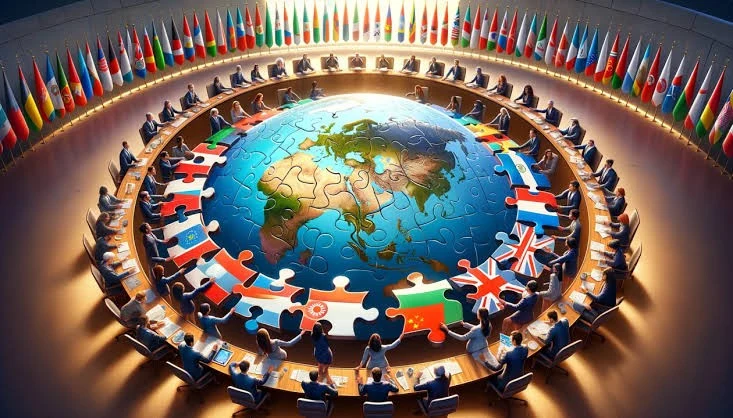
Yet for ordinary Indians, geopolitics ultimately becomes meaningful only when it affects daily life. Rising fuel prices, inflation, costlier imports, employment anxieties, and economic uncertainty shape public sentiment far more directly than summit photographs or diplomatic language. This is why many citizens feel simultaneously proud of India’s rising global profile and anxious about the economic pressures unfolding around them. The challenge before India, like much of the world, is not only how to navigate geopolitical transition abroad, but how to protect social and economic stability at home while the foundations of the global system itself are being quietly rewritten.
When supply chains, technologies, energy corridors, financial systems, and digital infrastructure become instruments of strategic competition, instability no longer remains confined to battlefields. It enters ordinary life. The coming years may therefore become economically harder for millions across the world, including societies geographically distant from active conflict zones. The burden will not always arrive dramatically. It may emerge slowly through rising costs, shrinking predictability, disrupted imports, cautious investment, fragile markets, and continuous economic anxiety.
Many governments are already quietly preparing for this reality. Energy insecurity linked to West Asia can affect transport and food prices globally. U.S.–China tensions can reshape manufacturing and technology access across continents. Export restrictions on strategic goods can disrupt entire industries. Shipping disruptions can raise inflation far away from the original crisis zone. Economic sanctions increasingly function as instruments of geopolitical warfare. Globalization once promised efficiency through interdependence. Today, that same interdependence is exposing how vulnerable modern societies have become to geopolitical fragmentation.
Ordinary people will feel these changes first, not through military briefings or diplomatic language, but through everyday life. Fuel becoming more expensive. Food prices rising unpredictably. Imported goods becoming costlier. Businesses delaying expansion. Investors moving cautiously. Employment becoming less secure. Governments prioritizing strategic resilience over economic openness. Citizens slowly adjusting to a world where uncertainty itself becomes economically expensive.
This is why many countries are already changing behaviour even before any full-scale global rupture occurs. Governments discuss supply-chain resilience, semiconductor independence, emergency reserves, localized production, strategic manufacturing, and digital infrastructure security with growing urgency. Nations are preparing not only for war, but for prolonged instability between wars. Economic security and national security are becoming inseparable.
That transformation carries enormous political consequences. Democratic governments will increasingly face public anger over inflation, shortages, unemployment, and declining affordability even when many of those pressures originate globally rather than domestically. Citizens experience economic pain locally regardless of where the original geopolitical trigger emerged. This creates a dangerous political atmosphere where governments are judged nationally for crises generated internationally. Social media intensifies this pressure by accelerating outrage faster than explanation. Rumours spread faster than policy clarity. Populations sense instability before institutions can fully explain it. As a result, many people increasingly feel that the world is changing fundamentally even if they cannot yet clearly define what the new system actually is.
The current transition resembles earlier power realignments where institutions continue functioning outwardly even as strategic realities underneath them begin changing. People living through major transitions usually experience confusion rather than clarity because old systems continue existing externally even while internally beginning to weaken. The present global order appears to be passing through exactly such a transition. The American-led post-Cold War structure is no longer fully dominant, yet no stable replacement has emerged. China is rising, but faces economic and strategic constraints. Europe remains influential but fragmented. Russia remains disruptive but economically pressured. Middle powers such as India, Saudi Arabia, Türkiye, Brazil, and others increasingly seek autonomy rather than dependency.
This creates a world where almost every major actor is recalibrating simultaneously without complete certainty about the final outcome. The danger is not only the possibility of military conflict. The greater risk may be prolonged global fragmentation where economies become more protectionist, technologies divide into rival ecosystems, trade becomes increasingly politicized, and societies gradually normalize instability as part of ordinary life. The coming world order may therefore not emerge through one catastrophic war alone. It may emerge gradually through economic pressure, strategic distrust, technological competition, sanctions, restrictions, and shrinking confidence spreading silently across societies.
Yet periods of instability have also historically produced reinvention alongside fragmentation. New institutions emerge. New alignments form. Economic systems adapt. Civilizations reorganize themselves when older structures stop functioning effectively. The future therefore remains open, even if uncertain. But one reality is becoming increasingly difficult to ignore. The world many people believed they understood only a decade ago is being quietly rewritten in real time, and most societies are only beginning to realize how deeply that rewriting may eventually reshape everyday human life.
Dr. Gaurav Vaid
Freelance Writer & Analyst
gauravvaid2010@gmail.com