When law begins to whisper and power begins to shout, the world slips into moral twilight. Gaza was not just another conflict; it was a reckoning. It laid bare the fault lines of a global order that speaks the language of law but listens to the dialect of power. The war’s bombs may have fallen on Palestinian soil, yet the debris scattered across the very foundations of the United Nations; the institution once built to keep the peace now struggling to justify its own relevance.
The UN was conceived out of the ashes of war and genocide. Its Charter carried the moral audacity of “never again.” It promised that human suffering would never again be met with silence or bureaucracy. Eight decades later, that promise has come undone. Gaza was the test that revealed it.
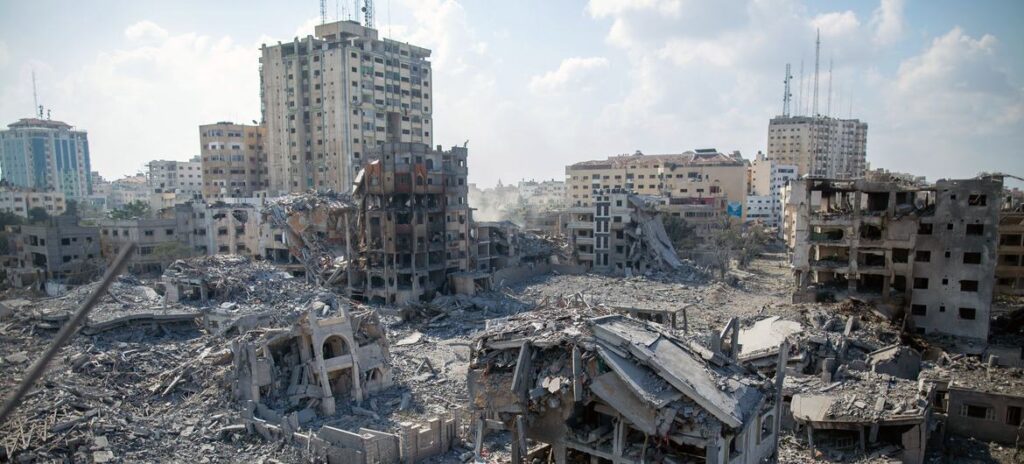
As thousands were killed and entire neighbourhoods turned to dust, the world’s conscience was divided by vetoes. The International Court of Justice urged preventive measures against possible genocide. The General Assembly voted repeatedly for a ceasefire. UN relief agencies pleaded for safe corridors, water, and fuel. Yet, at the Security Council; the very table where the fate of war and peace is meant to be decided — legality collided with geopolitics, and the veto triumphed over the voice of humanity.
The irony is unbearable. The veto, conceived to protect global stability, now protects the instability of the powerful. The moral architecture of 1945, built to prevent domination, has become an instrument to preserve it. In Gaza, the UN’s paralysis was not a failure of procedure; it was a failure of courage. The laws remained, the institutions stood, but the will dissolved.
This crisis did not begin in Gaza, but Gaza stripped away all pretence. For years, the UN’s moral authority has been quietly eroding under the weight of selective intervention and selective silence. Bosnia, Rwanda, Iraq, Syria, Yemen; each left behind a graveyard of resolutions and regrets. But Gaza was different because it unfolded in the glare of a hyper-connected world. Every airstrike was live-streamed, every corpse counted in real time, every appeal recorded, and still, the bombs fell. The crime was not ignorance; it was indifference refined into diplomacy.
The deeper tragedy is that Gaza may not be the end of an era but the rehearsal for the next. The same diplomatic paralysis that froze the UN in West Asia now shadows the Taiwan Strait, the South China Sea, Ukraine’s frozen frontlines, and Africa’s imploding states. Each new crisis carries the same foreboding message: that the world’s conscience can be switched off by a single vote in New York. If the rule of law cannot restrain the rule of force, then every war becomes not an aberration but an inevitability.
The UN’s credibility problem is structural, not circumstantial. It is the inevitable result of an institution that mirrors the power equations of a vanished world. The five permanent members of the Security Council still wield privilege as if the Cold War never ended. The rest of humanity — nearly two hundred nations — are invited to speak but not to decide. Reform has been debated for decades, but the vetoed reform remains the only consistent outcome. The UN has become democratic in aspiration but feudal in function.
This inequity corrodes not only politics but morality. When decisions about war and peace rest in the hands of a few, morality becomes the luxury of the many. The legitimacy of the UN’s decisions is now questioned not only by the defiant but by the disappointed. Gaza showed that legality, stripped of equality, is little more than legal theatre.
In the vacuum of trust, alternative architectures are rising. Regional alliances and new blocs from BRICS and the Shanghai Cooperation Organisation to the African Union and ASEAN are increasingly attempting what the UN no longer can: mediate, stabilise, legitimise. The world is drifting from a single centre of legitimacy to a marketplace of moralities. In this multipolar age, justice itself risks becoming transactional. The West invokes a “rules-based order,” yet those rules bend when the violator is a friend. The Global South calls for equity, but its unity often dissolves into self-interest. The result is a fragmentation of conscience; a global Babel of moral dialects, each fluent in hypocrisy.
And yet, within this disarray lies a moment of possibility. For India, this is neither a crisis to lament nor a vacuum to exploit, but a turning point to define leadership. India’s foreign policy has always carried a double mandate: moral idealism rooted in civilisation, and pragmatic realism forged by geography. As one of the original signatories of the UN Charter, India once stood as the conscience of the decolonising world. Today, as a major power, it must act as the bridge between the world’s lost faith and its future design.
India’s response to Gaza; advocating humanitarian access and the two-state solution while maintaining dialogue with all sides, exemplified this balance. It was not moral evasion but moral maturity: the ability to hold empathy and strategy together. In an age of binary diplomacy, such equanimity is itself an assertion of power. But India’s next task is larger; to shape the agenda of global reform rather than merely comment on its absence. Security Council expansion, veto reform, climate justice, equitable development; these are not abstract aspirations but the conditions of credibility for the 21st-century United Nations.
The UN’s moral legitimacy was once its greatest weapon. To lose it is to lose the very idea of collective conscience. For that reason alone, Gaza must not fade into the archives of humanitarian regret. It must remain the reminder that without accountability, law is performance; without equity, peace is illusion. The strength of the UN cannot lie in the number of its resolutions but in the courage of its enforcement.
There is a historical irony in watching the world’s conscience erode through the very institution built to preserve it. The League of Nations collapsed not because it lacked documents but because it lacked will. The United Nations stands perilously close to repeating that pattern — elaborate in design, impotent in action. The danger today is not that the UN will dissolve; it is that it will persist without purpose. Institutions rarely die suddenly; they decay slowly into irrelevance.
If the UN is to recover, it must begin where it once began, with the recognition that peace cannot depend on the permission of the powerful. Reform must start not from political convenience but from moral necessity. The veto must be restrained, representation expanded, and humanitarian intervention re-imagined as a global responsibility, not a geopolitical gamble. Above all, the UN must reclaim the language of accountability. Neutrality cannot mean moral amnesia.
For the world to trust again, the UN must learn to say “no” to the powerful, to the convenient, to the transactional. It must rediscover the audacity to name crimes even when committed by allies. Its Charter begins with the words “We the peoples.” Gaza has reminded us that those peoples are watching, and their patience is not infinite.
The next war — wherever it breaks — will not only test military power; it will test whether humanity still believes in shared justice. It will decide whether we live under a law of nations or a law of nature, where strength alone is right. The measure of civilisation will no longer be the scale of our progress but the limits of our cruelty.
The United Nations was never meant to be perfect; it was meant to be possible. But possibility demands courage, and courage demands consistency. If the institution cannot act when conscience calls, then it has already surrendered its soul.
Gaza should have been a warning that awakened reform. Instead, it has become the scar that deepens doubt. The next war is already being prepared; in the arsenals of nations, in the algorithms of propaganda, in the silence of diplomacy. It will not begin with gunfire; it will begin with indifference.
When the Charter was drafted in San Francisco, the world promised to save succeeding generations from the scourge of war. Eighty years later, that promise echoes hollow in the rubble of Gaza. History will not ask whether the United Nations met; it will ask whether humanity mattered.
After Gaza, the world does not need another resolution, another ceasefire, or another speech. It needs a conscience that cannot be vetoed.