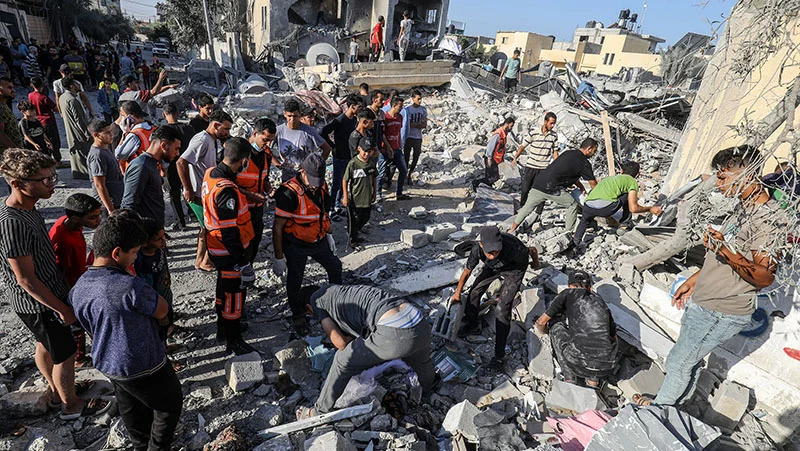
In the corridor of a bombed-out hospital in Rafah, a nurse carefully wraps the body of a child. There is no electricity. The morgue is full. No one has come to claim him.
Forty kilometres away in Sderot, sirens wail. Another rocket arcs across the sky. A father lifts his daughter from her bed and runs for the shelter. She asks, “Will this be the loud kind?”
The war between Israel and Hamas has devastated Gaza and scarred Israel. But on July 3, 2025, the conflict shifted from battlefield to courtroom. The UN Special Rapporteur for the Occupied Palestinian Territories declared that Israel’s campaign in Gaza may constitute genocide. It was not a rhetorical outcry—it was a formal invocation of the 1948 Genocide Convention, and a call to the world to act.
What followed wasn’t just a diplomatic tremor. It raised profound questions about law, morality, power—and what justice means in modern war.
A Charge Unlike Any Other
The term “genocide” is not casually applied. It implies deliberate intent to destroy a people, not just tragic consequences or reckless violence. The UN rapporteur cited indiscriminate bombings, the destruction of infrastructure vital to survival, and statements by Israeli leaders that she argues reflect dehumanising intent.
Her report called on the world to move beyond empty condemnation: to impose sanctions, halt arms sales, and hold corporations accountable for complicity in war crimes.
It is one thing to accuse a state of excessive force. It is another to accuse it of genocide—especially when that state is a democracy, a military ally of the West, and a nation forged in the aftermath of the Holocaust.
Israel’s Response: A War of Necessity, Not Annihilation
Israel has rejected the accusation as legally unfounded, morally perverse, and politically motivated. Its defenders point to Hamas’s actions: over 6,000 rockets launched at Israeli cities since October 2023; the use of schools, hospitals, and mosques to hide weapons; and cross-border tunnel attacks targeting civilians.
“We are at war with Hamas—not with Palestinians,” say Israeli officials. “We issue evacuation orders. We use precision munitions. We try to save lives while Hamas uses civilians as shields.”
Under Article 51 of the UN Charter, Israel claims the right to self-defence. The laws of war do not prohibit civilian casualties—but they demand that such casualties not be excessive in relation to the military advantage gained.
Critics point to the scale of destruction in Gaza—over 30,000 killed, many of them women and children—as proof that proportionality has failed. But Israel responds that asymmetric warfare defies easy arithmetic. Hamas embeds itself within civilian populations; its infrastructure is both human and hidden.
In such wars, no side can claim clean hands. But Israel insists it has not crossed the genocidal line.
The Legal Dilemma: When Law Meets Asymmetry
The Gaza war highlights a troubling truth: international humanitarian law is struggling to keep up with the realities of modern conflict.
The Geneva Conventions were designed for wars between states, not between states and non-state actors operating from within cities and refugee camps. When one side hides among civilians and the other uses smart bombs, who defines proportionality? What does “intent” mean when war is both everywhere and nowhere?
If the law is applied selectively, it loses credibility. But if it is applied too expansively, every counterterrorism operation becomes a potential genocide trial.
Therein lies the danger: that law, weaponised through inconsistent application, becomes either a shield for the powerful or a sword for the politicised.
India: Between Moral Legacy and Strategic Calculation
For India, this moment is not remote. It is an uncomfortable mirror.
India was once a fierce advocate for Palestinian rights. Nehru’s anti-colonial ethos guided India’s support for the PLO and the two-state solution. But in recent years, the India–Israel partnership has deepened—militarily, technologically, and ideologically. The Modi–Netanyahu axis, built on nationalism, security cooperation, and tech collaboration, has reframed India’s Middle East posture.
So far, India has abstained from UN votes, avoided harsh language, and called for restraint on “both sides.” But with BRICS allies like South Africa and Brazil leading legal action against Israel, India’s strategic ambiguity may soon be called into question—not only by the world, but by its own civil society.
Younger Indians, rights activists, and diaspora voices are increasingly vocal. They are asking: Can a Global South leader remain silent when international law is being reshaped?
India’s response may define not just its foreign policy—but its credibility as a moral actor in a multipolar world.
The Global South Speaks—And It’s Speaking in Law
What makes this moment historic is not only the gravity of the genocide charge—but who is echoing it.
South Africa took Israel to the International Court of Justice. Brazil, long cautious about confronting the West, is pushing for embargoes. Namibia, Chile, Bangladesh, and Bolivia have issued strong legal and moral condemnations.
This isn’t simply West vs Rest. It is the Rest finding its voice—and choosing law over slogans.
It is also a quiet rebuke to Western inconsistency. Many of the same nations that demanded accountability for Russia’s actions in Ukraine are hesitant to do the same for Israel. That double standard is not lost on the world’s majority.
If upheld, the Gaza case could redefine the power and promise of international law. If dismissed or ignored, it may signal its permanent decline.
Between Justice and Judgment
The genocide charge has sparked two fears.
One: that law is being hijacked to punish Israel unfairly.
Two: that justice will once again be sacrificed to geopolitics.
Both can be true.
What’s clear is that the world is no longer content with ceasefires. It is asking for consequences. But justice must mean more than condemnation. It must mean precision, fairness, and accountability for all—from Gaza to Yemen, Ukraine to Xinjiang.
Justice that is inconsistent is not justice. It is performance.
The Child and the Blackboard
There’s a photo circulating online. A boy in Gaza, ten years old, sits alone at a broken desk. The school’s roof is gone. His classmates are gone. He picks up a piece of chalk and writes his name on the blackboard.
That’s what law should do.
Not just punish the guilty—but protect the innocent. Make sure that a name isn’t forgotten. That a child isn’t erased from the world’s memory.
Back in Rafah, the nurse logs the death of another boy—”unknown male, approx. age 7.”
No legal verdict will bring him back. But what the world does next—in The Hague, in Delhi, in New York—will decide whether his death was a tragedy or a crime. Whether international law is a tool of the powerful—or a promise kept.
This is not just about Gaza. Or Israel. Or even the UN.
It is about what kind of world we live in when the death of a child becomes a legal debate, and the law itself stands trial
Why it matters?
If we accept that the death of a child can be debated but not prevented, that war can be waged without end but never truly judged—then international law becomes not a compass, but a casualty.
The question before us isn’t just whether Israel is guilty, or Hamas is cruel. It is whether the rules we wrote after Nuremberg and Rwanda still hold any weight in the age of drones, propaganda, and pre-emptive strikes.
For rising powers like India and others in the Global South, this is a test: of moral leadership, of legal consistency, and of their stake in a rules-based global order.
The choices made now—by courts, by governments, by civil society—will decide whether law restrains war, or merely follows it.