In a world veering toward fragmentation—where wars rage, alliances fray, and global governance falters—BRICS stands at a defining crossroads. What began as a clever acronym coined by a Goldman Sachs economist has evolved into a sprawling, if uneasy, coalition of diverging national interests. Today, with over 40% of the world’s population, vast energy reserves, and a rising share of global GDP, BRICS is no longer a symbolic club—it’s a geopolitical force.
Its recent expansion—welcoming Saudi Arabia, Iran, Egypt, the UAE, and Ethiopia—signals ambition, but also deepens contradictions. Some members are locked in rivalries. Others are embroiled in active wars. And the most powerful among them increasingly act alone.
BRICS was envisioned as a challenger to Western dominance and a voice for the Global South. But in a world beset by climate crisis, economic inequality, and violent disorder, the question is no longer whether the world needs a counterbalance—it does. The real question is whether BRICS, fractured from within, is capable of being that force—or whether it will remain a stage for symbolic dissent in a system it cannot yet reshape.
Geopolitics on Fire: The Vacuum BRICS Could Fill –
From the Russia–Ukraine war to the Iran–Israel conflict, from rising tensions in the Taiwan Strait to Red Sea shipping crises and Indo-Pacific militarization, the post-Cold War global order is under siege. Institutions like the UN Security Council are paralysed, frequently vetoed into irrelevance. Meanwhile, voices from the Global South grow louder—demanding not charity, but a genuine seat at the table.
By all measures, this should be BRICS’ defining hour. Instead, it teeters between promise and paradox.
Yet, there’s a brutal irony at play: some of BRICS’ own members are central players in today’s most dangerous conflicts.
- Russia is waging war in Ukraine.
- Iran is in open confrontation with Israel.
- China flexes military power in Taiwan and the South China Sea.
- Ethiopia faces domestic unrest.
These lay bare the tension between the bloc’s aspirational role as a peace-seeking coalition and the geopolitical realities its members represent.
China: Dominant Power, Diverging Vision –
The greatest asymmetry within BRICS lies in China’s overwhelming economic clout, contributing nearly 70% of the bloc’s original GDP. For Beijing, BRICS is a geopolitical tool to counterbalance the U.S.-led order, especially G7 institutions.
But China’s aggressive posture—from its maritime claims to its border tensions with India—suggests a preference for unilateralism over consensus. BRICS, in this vision, becomes less a multilateral platform and more a megaphone for Chinese soft power.
For New Delhi, China’s pursuit of dominance—not just economically but territorially—is a red flag, not a rallying point. This creates persistent friction with India.
Russia: War-Torn but Still Assertive –
Post its 2022 invasion of Ukraine, Russia is no longer an economic equal within BRICS but a geopolitical disruptor. Isolated by Western sanctions, Moscow turns to BRICS not as a forum for development but as a geopolitical shield.
It champions de-dollarization and a new financial order, but with diminished economic leverage to support it. As Russia leans further into Beijing’s embrace, the bloc risks becoming less multipolar and more bipolar in tone—dominated not by dialogue, but by duopolies.
Russia wants BRICS to confront the West. Others want it to complement a rebalanced system. This internal divergence is the bloc’s fundamental fault line.
India: The Equidistant Bridge –
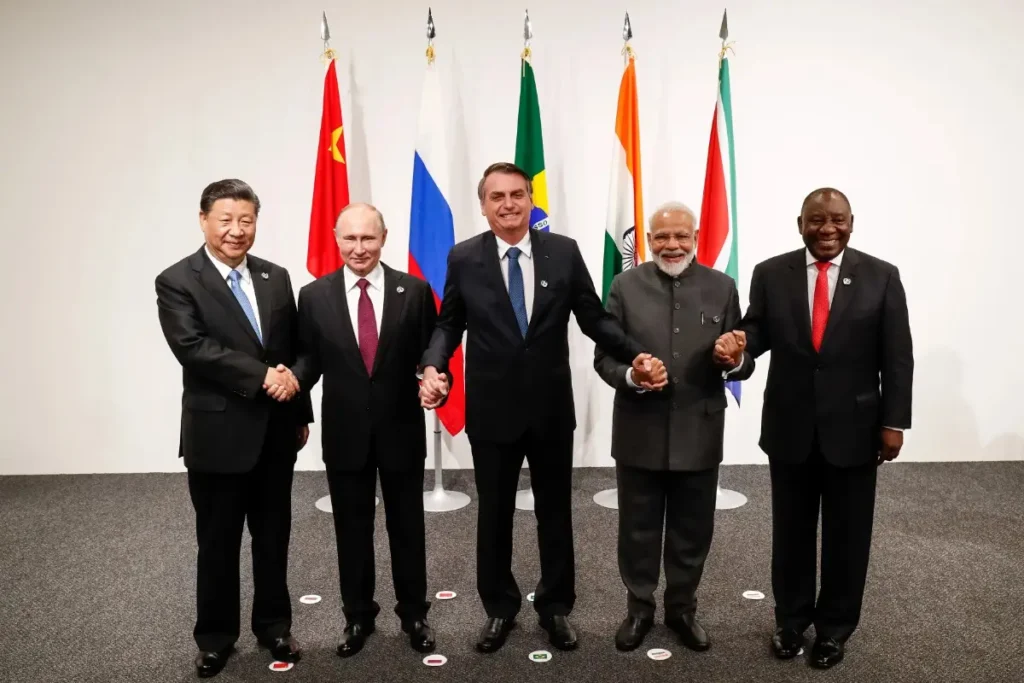
Among BRICS members, India is perhaps the only one simultaneously deepening tie with the West (via the QUAD, I2U2, and strategic partnerships) while investing in alternative platforms like BRICS and the Shanghai Cooperation Organisation (SCO).
India does not endorse BRICS as an anti-Western coalition. Instead, it sees the bloc as a lever for reform, a vehicle for elevating Global South priorities—from climate justice and development finance to its model of Digital Public Infrastructure (DPI).
Unlike China, India doesn’t seek dominance. Unlike Russia, it doesn’t seek disruption. India seeks a world order that works for all, not just for the historically privileged.
In a divided world, India isn’t choosing sides. It’s trying to redefine the game. If it can steer BRICS towards constructive engagement rather than confrontational alignment, its leadership could be transformative.
Expansion: More Voices, or Just More Noise? –
The 2023 BRICS expansion was historic, bringing in Saudi Arabia, UAE, Iran, Egypt, and Ethiopia. Now, the bloc collectively accounts for over 40% of global oil supply. But with this growth comes greater incoherence:
- Iran and Saudi Arabia only recently resumed diplomatic ties—and remain regional rivals.
- Ethiopia faces domestic unrest and instability.
- Argentina, initially invited, chose not to join.
Rather than synergy, the expansion risks cacophony. With ideological opposites and rival regional agendas, the ability to deliver meaningful outcomes is uncertain. Instead of a “BRICS+,” we risk a “BRICS±”—a messy equation where additions subtract clarity.
BRICS vs G7: Mirror or Mirage? –
The G7 is united by political systems and values. BRICS, by contrast, is defined by its diversity—which is both its strength and its Achilles’ heel.
- It lacks a permanent secretariat.
- There is no unified policy coordination.
- Its financial arm, the New Development Bank (NDB), has had limited impact.
- The much-discussed BRICS currency remains aspirational.
And yet, BRICS remains a powerful narrative force. In global forums like the UN, WTO, and IMF, it serves as a collective voice of dissent—a symbol of the Global South’s growing impatience with a world order seen as unequal and outdated.
Yet narrative without machinery becomes myth. Its ambitions are grand, but its architecture remains hollow.
Multipolarity or Multilateral Gridlock? –
The world is no longer unipolar. But nor is it comfortably multilateral. Instead, we are in a period of messy transition:
- The U.S. is retrenching and recalibrating.
- China is rising but divisive.
- Europe is distracted and internally divided.
- The Global South is demanding more than token inclusion.
To truly matter, BRICS must stop asking what it’s against—and start declaring what it’s for. It must evolve from a forum of speeches into a platform of solutions:
- Institutionalize deeper cooperation.
- Align on peace-building initiatives.
- Go beyond opposing the West to proposing global public goods.
So far, it has mostly postured. But the world is watching.
Message or Movement in a World at War?
BRICS today straddles a geopolitical fault line—not just metaphorically, but literally. Some of its key members are already deeply embroiled in conflicts:
- Russia is waging war in Ukraine.
- Iran and Israel are in open, escalating hostilities.
- China flexes military power in the Taiwan Strait and South China Sea.
- Ethiopia remains gripped by domestic unrest.
The bloc, born out of a dream of shared development, now risks becoming a platform riddled with contradictions—a coalition that calls for peace while some of its members fuel war.
Its future will be defined not by the size of its membership, but by the substance of its purpose. Can it evolve from a club of crisis-managers into a genuine architect of peace, development, and global equity?
For India, this moment is pivotal. If it can help recast BRICS not as an echo chamber of grievances but as a force for reform, resilience, and resolution, it will not just rise—it will lead.
Because if BRICS can’t lead in a world on fire, it may lose the right to speak when the ashes settle.