At 7:34 AM this Independence Day, Prime Minister Narendra Modi began what would become the longest Red Fort address in Indian history. By the time he concluded at 9:17 AM; a marathon 103 minutes, later he had broken his own record, outpaced last year’s 98-minute speech and left every Prime Minister before him, including Jawaharlal Nehru, in the shade. This was more than an address to the nation; it was a policy rollout, a campaign pitch, and a geopolitical signal, all wrapped in the ceremonial flag-hoisting of India’s 79th Independence Day.
The sheer length was symbolic. Modi’s speeches from the Red Fort have always been sprawling, but this one felt like a deliberate attempt to frame the coming years as a decisive chapter in India’s story. If earlier speeches built the scaffolding, this one aimed to lay the final beams for what he calls Viksit Bharat, a fully developed India by the time the nation turns 100 in 2047.
Independence Day speeches are, by nature, both ceremonial and political. Modi has historically used them to blend achievements with forward-looking promises. In 2014, his first, he spoke like a reformist outsider, dismantling the idea of “policy paralysis.” In 2019, the emphasis was on national mobilization from Swachh Bharat to Ayushman Bharat, designed to rally the public around transformational schemes. This year, the tone was more like that of a statesman charting a long-term legacy. Gone were the long anecdotes and rustic flourishes. In their place came hard targets, timelines, and a steady drumbeat of policy announcements tied to Viksit Bharat. The shift was telling: in year eleven of his premiership, Modi is no longer only trying to convince Indians of his vision, he is staking his credibility on delivering it.
At the heart of the speech lay a trio of domestic promises. First, a sweeping GST reform set for October, pitched as a “Diwali gift” to ordinary Indians. By simplifying slabs and reducing rates on common-use goods, Modi promised not just tax relief, but a more predictable economic environment. This was both consumer-friendly policy and subtle political timing, aligning relief with the festive season, and inevitably, with voter sentiment.
Second, the launch of the Pradhan Mantri Viksit Bharat Rozgar Yojana; a ₹1 lakh crore employment scheme targeting 3.5 crore jobs over the next two years. Its design direct incentives for first-time employees, subsidies for companies expanding their workforce, tied job creation directly to private-sector growth and addressed the urgent aspirations of India’s youth.
Third, the emphasis on technology and self-reliance. The announcement that India’s first indigenous semiconductor chips will roll out this year was framed not as an industrial achievement, but as a civilisational milestone. It was paired with an ambitious plan for an Indian space station, presented under the mantra daam kam, dum zyada — “low cost, high strength.” The message was clear: India will innovate on its own terms, at its own price point, and still compete globally.
Modi blurred the lines between economic progress and national defence, underscoring that one cannot exist without the other. The unveiling of the ‘Sudarshan Chakra’ defence system was as much a symbolic gesture invoking the mythic weapon of Lord Vishnu as it was a strategic announcement. It dovetailed with the recent success of Operation Sindoor, a cross-border counter-terrorism operation, which he linked explicitly to Atmanirbhar Bharat (self-reliant India).
Here, the message to Pakistan was unambiguous: the days of quiet restraint are over, and any act of terrorism will invite a calibrated but decisive response. He stopped short of sabre-rattling, but the symbolism was potent enough for the intended audience. “His unequivocal stance on rejecting nuclear blackmail, calling the Indus Water Treaty ‘unjust’ and refusing to allow shared water resources to be leveraged against Indian farmers, and refusing to distinguish between terrorists and their backers sent Pakistan a clear deterrent: India’s red lines are redrawn.”
In an unusual but significant moment, Modi turned his attention to trade relations, delivering a subtle warning to the United States over recent tariff hikes on Indian steel, aluminium, and electronics. Without naming Washington, he spoke of nations that must “practice fairness, not fear” in commerce. The framing was deliberate; it positioned India not as a protectionist economy, but as a quality-driven exporter unwilling to be boxed in by another country’s domestic politics. To the United States and global economic watchers, Modi projected a firm posture: India’s development won’t pause for trade intimidation. His carefully chosen words about self-reliance and fairness were both a rebuke to protectionism and an affirmation of Indian industrial resilience.
This, too, was part of the Viksit Bharat vision. A developed India, in Modi’s telling, is one that negotiates trade on equal terms, friendly with all, dependent on none. The message was also meant for Beijing, Brussels, and other capitals: India is open for business, but it will set the terms for its engagement. In this year’s address, Modi also made it unmistakably clear that India’s national trajectory will no longer be derailed by external pressures; whether from a hostile neighbour, economic coercion, or diplomatic brinkmanship.
Beyond the marquee schemes, the Prime Minister touched almost every sector: new irrigation and crop diversification schemes to boost farmer incomes; expanded free diagnostic services in government hospitals; fast-tracked expressway projects linking tier-2 and tier-3 cities; and a commitment to 50% renewable energy capacity by 2030, anchored in green hydrogen. Each was positioned not as an isolated policy, but as a chapter in the Viksit Bharat story. This framing allows disparate initiatives to appear as parts of a single, cohesive national mission.
Where most leaders might choose brevity, Modi leaned into length. The 103-minute record ensured no rival political message could compete for the day’s headlines. It allowed him to touch every demographic — farmers, youth, entrepreneurs, scientists, soldiers, and weave them into a single, uninterrupted narrative of progress, resilience, and pride. There is a calculated discipline to this style. In an era of soundbites and viral clips, a long speech serves as a manifesto-in-motion. It is also “scrutiny-proof” in its breadth — agencies, fact-checkers, and opposition leaders can pick apart details, but the overarching theme remains dominant in public memory.
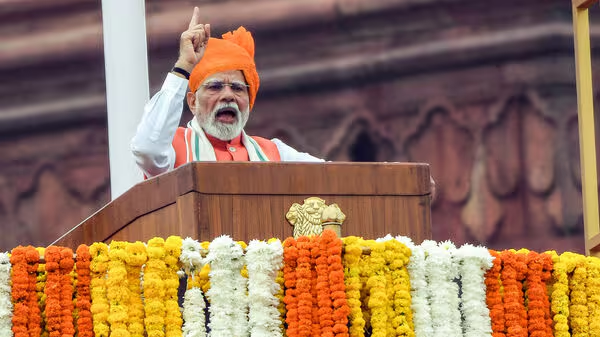
Compared to previous years, there was less anecdotal storytelling and more programmatic detail. This shift matches the maturity of his tenure: in year 11 as Prime Minister, the emphasis is moving from rallying support to defining a legacy. Independence Day speeches are both vision statements and political theatre. The record length is symbolic, but the real test will be delivery. GST reform timelines, job creation targets, semiconductor production deadlines; all will be closely tracked. Modi himself seemed aware of this, using phrases like “the world will see” and “you will remember” — signalling not just intent, but a challenge to his critics to hold him accountable.
History offers a caution: past Red Fort promises, from river-linking projects to bullet train deadlines, have seen mixed outcomes. The agencies, media, and electorate will scrutinize this year’s pledges no less rigorously. Ultimately, the 79th Independence Day will be remembered for three things: the historic length of the speech, the centrality of Viksit Bharat as a unifying development doctrine, and the fusion of domestic policy with global positioning. Whether it becomes a true milestone in India’s journey will depend not on the record-breaking address at the Red Fort, but on the months and years of governance that follow.
Beneath the policy layers was a human narrative; one that Modi has cultivated for over a decade. References to farmers’ resilience, the aspirations of young graduates, and the sacrifices of soldiers served to ground the grand vision in everyday realities. Even as hespoke of space stations and global trade, he returned to the language of family and community, “our youth,” “our mothers,” “our soldiers.” This balance turns what could be a technocratic blueprint into a national story in which every citizen has a role.
From the Red Fort this year, Modi was speaking to more than the 1.4 billion citizens watching at home. He was speaking to Washington about tariffs, to Islamabad about terrorism, to Beijing about resilience, and to global markets about India’s place in the 21st-century economy. In his telling, Viksit Bharat is not about asking for a seat at someone else’s table. It is about building India’s own — designed in India, made in India, and set for the world.
If this unprecedented address was a blueprint, the next two decades will be the construction phase. The applause at the Red Fort will fade, but the judgment will be written in factories, in classrooms, at borders, and in trade corridors. For now, August 15th, 2025, will be remembered as the day India’s Prime Minister laid out not just a vision of development, but a declaration of intent to the world: India will rise, and it will do so on its own terms.