Between mistrust and necessity, India and China stand divided by the Himalayas yet bound by history, economics, and geopolitics; reminding Asia that its future may hinge not on who bends, but on who endures.
When Chinese Foreign Minister Wang Yi landed in Delhi this week, the diplomatic corridors stirred with speculation. Commentators immediately split into two camps: some called it a breakthrough, others whispered that India had bowed before Beijing’s assertiveness. Such binaries, however, miss the layered complexity of the moment. India and China are not adversaries in the traditional sense, nor allies in the conventional one. They are two civilizational states whose fates are entangled by geography, history, and ambition, navigating a relationship that is simultaneously adversarial and interdependent. Wang Yi’s visit is less about bowing or bending than about testing whether two Asian giants can move from frozen hostility toward cautious coexistence without either side losing face.
The memory of Galwan still looms large; a brutal clash in May 2020 that claimed lives on both sides and shattered the fragile trust that had sustained decades of uneasy peace. It ended the comfortable fiction of “Hindi-Chini Bhai-Bhai” and forced New Delhi to recalibrate its China policy with far greater caution. Since then, while multiple rounds of military and diplomatic talks have sought disengagement, the Line of Actual Control (LAC) remains tense, trust is eroded, and India has moved to deepen strategic hedges through the Quad and other partnerships in response to Beijing’s assertiveness.
Since then, disengagement has been partial, dialogue intermittent, and troop deployments along the LAC more entrenched than ever. India has repeatedly stressed that normalisation of relations cannot proceed without restoration of peace and tranquillity at the border. This principle was reiterated during Wang Yi’s visit: the boundary is not a side issue; it is the core issue. Beijing has often sought to compartmentalise; expanding trade and cooperation while freezing the dispute in place. New Delhi has refused to delink, insisting that stability on the frontier is the necessary foundation for any broader partnership. This is more than semantics; it reflects two divergent worldviews.
Recent exchanges between Wang Yi and External Affairs Minister S. Jaishankar reflected this paradox of mistrust and necessity. The talks carried no illusions of breakthrough, yet both sides sought to keep communication alive. For India, dialogue is a means to manage risk without diluting resolve; for China, it is a way to prevent tactical tensions from derailing its broader regional calculus. Strategic meetings thus become less about agreement and more about controlled endurance.
Yet paradoxically, trade between India and China has soared even as political ties have frozen. Bilateral trade crossed $135 billion in 2022, making China India’s largest trading partner. Indian pharmaceutical, software, and services sectors depend on Chinese raw materials and hardware; Chinese firms still dominate India’s solar and electronics supply chains. For India, this entanglement underscores the urgency of diversification, the push for “Atmanirbhar Bharat,” stronger links with the West, ASEAN, and Japan. For China, it highlights the risks of overplaying coercion in South Asia at a moment when its own economy is slowing. The U.S. tariff escalations against China have added another layer to this picture. As Washington shuts doors on Chinese exports, Beijing is tempted to seek stability with other large markets including India, yet Delhi’s guarded stance denies Beijing an easy substitute. This dynamic amplifies India’s leverage, showing that global trade disruptions can reshape regional calculations. This uneasy coexistence of economic interdependence and military hostility is the essence of what has come to be described as “competitive coexistence.”
Even amid confrontation, economics remains a stubborn tether. India’s tariff walls and scrutiny of Chinese investments have altered the balance, but Beijing still finds in India both a lucrative market and a critical node in supply chains. For New Delhi, the trade deficit with China underscores dependency, even as diversification efforts signal intent to reduce leverage. Economic ties may not soften geopolitics, but they ensure neither side can fully decouple.
India’s strategic posture today rests on a careful balancing act. On one hand, New Delhi has deepened cooperation with the United States, Japan, and Australia through the Quad, enhancing its role in the Indo-Pacific’s security architecture. On the other, it continues to participate in platforms like BRICS and the Shanghai Cooperation Organisation, where Beijing’s influence looms large. India’s dual approach signals that alignment is not binary; it seeks flexible coalitions that serve its interests without forcing a permanent tilt. For Beijing, India’s growing closeness to Washington is a concern. Yet China also recognises that a hostile India firmly aligned with the U.S. would complicate its regional ambitions. For New Delhi, the China challenge is structural, but not necessarily one that requires open conflict. What emerges, then, is a wary equilibrium: neither partnership nor hostility, but contested cohabitation in Asia’s strategic theatre.
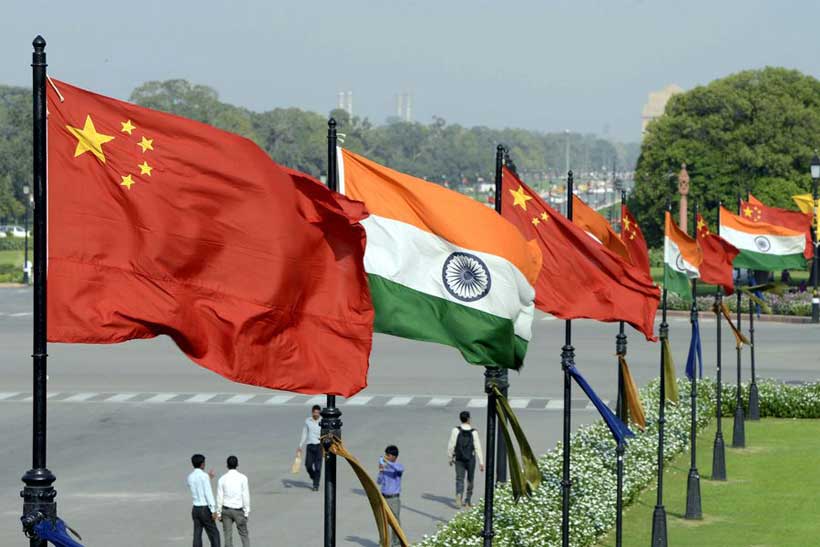
The Indo-Pacific has become the world’s most consequential geopolitical arena. China’s assertiveness in the South China Sea, its Belt and Road Initiative, and sharpening rivalry with the U.S. have redrawn lines of competition. India, straddling the Indian Ocean while sharing a contested Himalayan frontier, is both participant and prize in this contest. Its choices carry weight far beyond bilateral ties.
Domestically, India projects growing confidence. Its economy is among the fastest growing globally, its diplomatic profile has risen through G20 leadership, and its military modernisation is accelerating. Yet beneath this confidence lies vulnerability: dependence on imported energy, exposure to global supply chains, and unresolved border tensions with China. Beijing, meanwhile, faces its own pressures; economic slowdown, demographic decline, and resistance to its global assertiveness. These simultaneous strengths and fragilities make both powers cautious, yet unwilling to concede ground.
The Pahalgam attack and its diplomatic fallout highlighted another layer of unease. China, while lending rhetorical support to Pakistan, stopped short of overt escalation; acting with calculated restraint. For New Delhi, this duality is both a warning and a window: Beijing will back Islamabad when convenient, but it will calibrate its stance to avoid jeopardising its own regional interests. That ambiguity leaves India wary, but also aware that China’s pragmatism can be leveraged.
This context explains why Wang Yi’s visit cannot be read as capitulation. To engage diplomatically is not to submit. India’s refusal to freeze the border dispute, its military build-up in Ladakh and Arunachal, and its diversification of strategic partnerships with the U.S., France, Japan, and Australia demonstrate anything but weakness. Indeed, Delhi’s strategy has been one of calibrated duality: firm deterrence at the LAC combined with an open diplomatic channel to prevent war. Unlike distant powers, India cannot wish China away. Nor can it afford to drift into the role of a junior partner. The middle path is not weakness; it is necessity.
The geopolitical stakes extend beyond the Himalayas. China’s inroads into South Asia and the Indian Ocean, ports in Sri Lanka, roads in Nepal, influence in the Maldives are read in Delhi as encirclement. Beijing calls it connectivity; India calls it coercion. The Belt and Road Initiative (BRI), which India has steadfastly opposed, epitomises this clash. Wang Yi’s trip was unlikely to soften Delhi’s stance, but it allowed Beijing to test whether smaller confidence-building steps might open space for dialogue.
For China, stabilising ties with India serves a pragmatic purpose. With its tensions with the U.S. deepening, its economy slowing, and ASEAN countries pushing back against its South China Sea assertiveness, Beijing cannot afford escalation with Delhi. For India, the incentive is equally clear: preserving strategic autonomy. If it collapses into a purely anti-China alliance with Washington, it risks losing manoeuvring space. If it yields too much ground to Beijing, it risks sovereignty and credibility. The art lies in maintaining enough engagement to avoid isolation while signalling enough firmness to deter aggression.
The story of Indo-China relations is therefore less about breakthroughs and more about endurance. Border talks may yield incremental disengagement, but the fundamental dispute remains unresolved. Trade may remain high, but strategic distrust runs deeper. India will continue to strengthen ties with the U.S. but will stop short of alliance. China will continue probing India’s resolve at the LAC but will avoid a full-blown war. This uneasy equilibrium could persist for years, shaping Asia’s order through managed tension rather than resolution.
For India, this moment underscores the importance of resilience. It must prepare for a prolonged era of contestation, where agency lies in shaping terms of engagement rather than seeking quick resolution. Expanding leverage means strengthening ties not just with Washington, but also Southeast Asia, Africa, and Europe. Most critically, investing in domestic capacity—economic growth, technological innovation, and military readiness, remains the foundation of true strategic agency.
Equally important, India must not let the China question consume its foreign policy imagination. While managing Beijing is essential, reducing India to a reactive counterweight diminishes its global potential. The Asian order is being rewritten not only by U.S.–China rivalry, but also by the rise of middle powers, shifting trade routes, and new technologies. India’s role is to be a shaper of this order, not merely China’s adversary, but a pole in its own right.
As Wang Yi departed Delhi, no dramatic breakthroughs were announced, no joint declarations redefined the relationship. But perhaps that is the point. In an era where perception often overshadows substance, the absence of drama is itself a signal: that neither side seeks rupture, and both are willing to at least keep the conversation alive. For a relationship as fraught and consequential as that between India and China, sometimes the survival of dialogue is itself a form of progress.
Indo-China relations are indeed at a new turn; not of trust, but of necessity; not of friendship, but of coexistence. To call it bowing is to underestimate India’s agency. To call it a breakthrough is to overstate Beijing’s flexibility. The reality lies in between: a fragile balancing act of rivalry and restraint, deterrence and dialogue. Geography ensures India and China cannot escape each other; history ensures mistrust will linger; economics ensures interdependence will persist. The test is not who dominates, but whether both can endure without imploding the order they seek to shape.