In a democracy, silence can be protest. But when too many institutions fall quiet, it begins to sound like submission.
As the Monsoon Session of 2025 began in Parliament, an eerie quiet preceded the storm. The seats were filled, but voices withheld. Opposition parties chose symbolic silence, not as abdication, but as accusation. In a democracy that promises deliberation, their protest asked a deeper question: when speech is ignored, is silence the only language left?
What was expected to be a symbol of democratic renewal, a forum for spirited debate, legislative foresight, and national course correction, now risks becoming an uneasy theatre of protest and paralysis. The impasse reflects not just a political rivalry between government and opposition, but a deeper institutional dilemma: can the machinery of democracy function when its parts no longer speak to each other?
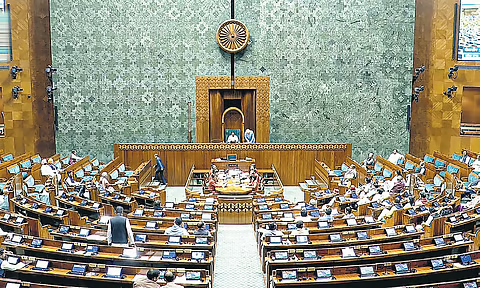
Yes, parliamentarians are indeed sitting silently, but this is no act of apathy. In the opening days of the session, opposition MPs embraced silence not as surrender, but as strategy. Choosing not to disrupt or debate, they staged a symbolic protest within the very walls meant for deliberation. With arms folded and voices withheld, they sat in quiet defiance, echoing a deeper unease that when parliamentary speech is reduced to ritual, silence may be the only form of resistance left. In a space designed for dialogue, their stillness became its own kind of indictment.
The Monsoon Session has left us with an image that is difficult to forget: rows of MPs sitting silently, some draped in black, others with gags across their mouths. No slogans, no disruptions, no desk-thumping chaos, just a collective stillness that asked louder questions than words could. This orchestrated silence was not apathy, it was anguish. A response to the violence in Pahalgam, yes, but also to a larger political climate in which Parliament seems increasingly distant from the people, and from its own purpose. A temple of debate now echoes with silence not because there is nothing to say, but because no one is listening.
India’s Parliament has long been noisy, argumentative, even chaotic, but that noise was democracy breathing. Today’s silence is not peace. It is a warning. Protest has become performance, and legislation a one-sided act. Walkouts, gags, and black bands make for powerful visuals but they are also signs of desperation in a space that no longer permits dissent with dignity. The government’s refusal to allow a structured debate on Pahalgam and the opposition’s choice to go silent, reflect a deeper fracture. When speech is denied, silence becomes resistance. But what happens when even resistance begins to feel futile?
Outside Parliament, the public rages. Inside, MPs sit in protest. The disconnect is glaring. Citizens turn to streets and screens for catharsis, while their elected representatives are muted in the House. This raises a difficult question: has the centre of democratic gravity shifted from Parliament to the public square? Debates now happen more on television panels and social media than on the floor of the House. This outsourcing of deliberation has dangerous implications, it replaces accountability with outrage, and policy with performance.
In this vacuum, many turn to the Supreme Court, hoping for constitutional clarity. But the judiciary walks a fine line between restraint and relevance. In recent years, it has been both an assertive guardian and a reluctant observer. When Parliament refuses to debate, should the Court step in? Or would that blur the separation of powers even further?
Meanwhile, deliberative democracy doesn’t just die in televised silence, it withers slowly in underused Standing Committees and rushed legislation. The number of bills sent for detailed scrutiny has sharply declined over the past decade. What we lose in that process is not just detail, but depth, and dissent.
The tragedy of Pahalgam, like Manipur, like Hathras, like so many before — should have led to institutional soul-searching. Instead, it became another episode in the ongoing war for narrative control. The government blames the opposition for derailing Parliament; the opposition accuses the government of stifling debate. Meanwhile, truth falls between the cracks. The casualty here is not just communication, it’s credibility. In the battle of optics, the people lose perspective. They see gestures but not governance.
At the heart of the current standoff is the opposition’s demand for a debate on the recent revision of Bihar’s electoral rolls — dubbed SIR, or “Silent Invisible Rigging.” While the matter has sparked widespread political attention, the government, citing the Election Commission’s constitutional independence, has resisted what it sees as an attempt to cast aspersions on institutional integrity. The result is familiar: disruptions overshadow deliberations, and critical legislation stalls. Only one bill — the Goa ST Reservation Readjustment Bill has been passed so far. Other urgent matters, from sports reforms to economic initiatives, remain in limbo. Yet this isn’t merely an administrative lapse. It’s a moment that asks: how can democracy perform when its performers have abandoned the script of dialogue?
To its credit, the government has outlined a robust legislative agenda focused on national growth, governance transparency, and federal harmony. Ministers have signalled a desire to maintain economic momentum and infrastructure investment amid global volatility. The extension of President’s Rule in Manipur, for instance, was a necessary step for stability even if peace remains elusive. But in the face of relentless opposition roadblocks, calls to bypass debate entirely in the name of “national interest” tread a fine line. Efficiency must not come at the cost of democratic process. True strength lies not just in numbers, but in the patience to listen, the courage to explain, and the discipline to persuade.
One of the most serious yet subtle, undercurrents in this session is the growing crisis of institutional trust. The government rightly asserts that bodies like the Election Commission, Supreme Court, and CAG deserve respect and faith. But respect must be earned and safeguarded through openness, not opacity. Opposition leaders, for their part, must go beyond slogans. If allegations like SIR are serious, they must be backed by evidence, process, and constitutional means; not disruption and walkouts. Democracy cannot afford either blind faith or reckless distrust. It needs constructive accountability.
Beyond the well-lit halls of Parliament, the Union–State dynamic is undergoing a quiet transformation. The Centre’s decision to suspend MGNREGS and housing scheme funds to West Bengal citing misuse, is seen by some as fiscal discipline, and by others as political messaging. Southern states have renewed anxieties over impending delimitation, fearing marginalisation. In Kashmir, leaders like Omar Abdullah are once again raising the call for statehood restoration, invoking both constitutional propriety and public sentiment. These are not mere flashpoints, they are signs that India’s federal architecture needs regular dialogue, not just directives.
Even as geopolitical winds shift from American pressure over Russian oil to India’s growing voice in multipolar platforms; domestic cohesion remains the first test of global credibility. A Parliament that cannot pass reform bills or debate national priorities weakens India’s ability to project confidence abroad. The world watches not just what India says internationally, but how it governs internally.
There is no denying the complexity of the present moment. The government must govern. The opposition must scrutinise. But both must do so in the spirit of responsibility, not retaliation. Let Parliament discuss —not derail. Let institutions be protected — not politicised. Let governance remain transparent — not transactional.
This Monsoon Session must not end as a lost opportunity. It must emerge as a democratic correction point, where political maturity replaces noise, and process reclaims its rightful place from posturing. India does not suffer from too much democracy. If anything, it suffers from too little democratic patience. Parliament is not a battlefield to win, but a mirror to reflect the nation’s hopes, fears, and contradictions.
In moments like these, it’s not the loudest voices, but the quiet resilience of constitutionalism that must lead.