From London’s anti-immigration rallies to walls rising worldwide, humanity faces a stark choice: to retreat behind borders of fear, or to build bridges of shared strength.
When we were children, many of us carried a simple dream. We were told: study hard, earn your place, and the world will open its doors. Some imagined flying to London or New York for higher studies. Others wanted to work in Germany’s factories, America’s labs, or Australia’s hospitals. Migration, in those days, felt like a bridge; a way to cross from scarcity to opportunity, from small towns to the wide world.
The dream feels more fragile now.
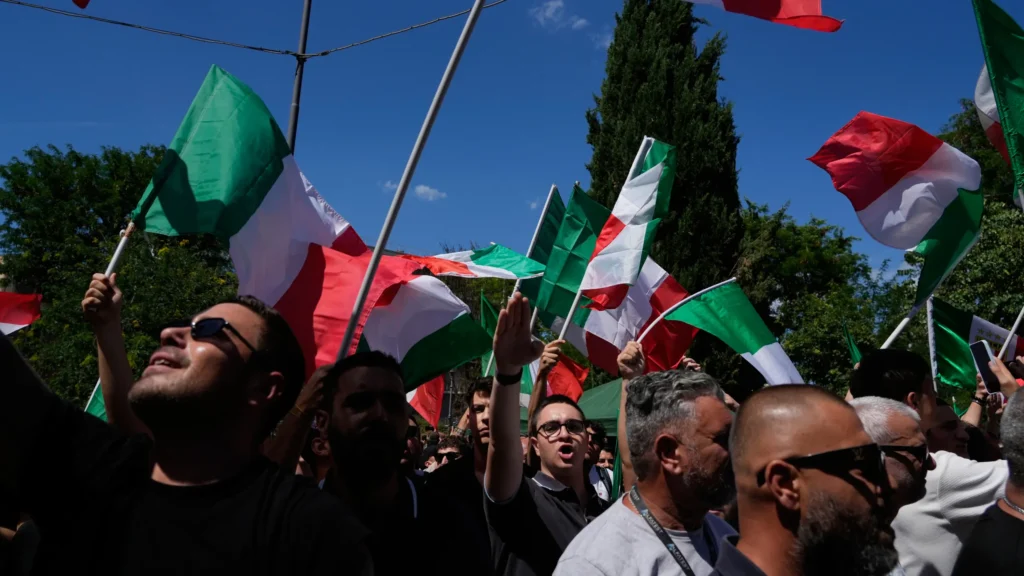
But look at London today. A hundred thousand people filled its streets under banners of “Unite the Kingdom.” They waved flags and shouted, “send them home.” Police officers were punched, kicked, and injured as anger spilled into violence. The rally was described as about “free speech,” but the chants and the slogans revealed the real target: migrants — people like the students we once dreamed of becoming, or the doctors and nurses who now keep the UK’s health service alive.
London is not alone. Poland has seen anti-immigration protests in more than 80 cities. Australia has witnessed its own “March for Australia,” with thousands clashing with counter-protesters in Sydney and Melbourne. Dublin saw thousands rally against newcomers. Berlin’s streets filled with tens of thousands opposing immigration reforms. The pattern is unmistakable: from London to Warsaw, Sydney to Dublin, the world’s public squares are filling with anger at migration.
For a generation that grew up believing borders were gateways to opportunity, this is a painful reversal. Migration was once framed as a form of global citizenship; you went abroad to study, to work, to learn, and perhaps to return home carrying skills and networks. Even those who stayed abroad were often celebrated for sending remittances, building bridges between cultures, and keeping family economies afloat.
Today, those very pathways are narrowing. Where once “going abroad” was a dream, it is now framed by suspicion: “Are you taking our jobs? Changing our culture? Draining our welfare system?” What we imagined as a two-way exchange is increasingly seen as a one-way threat.
To dismiss these protests as mere racism would be too simple, though racism undeniably feeds them. Beneath the banners lie deep anxieties:
—Economic Pressure: Wages feel stagnant, housing costs unbearable, and public services overstretched. Migrants, visible and different, become the easiest scapegoat.
—Cultural Anxiety: People fear losing their sense of “home.” The neighbourhood they grew up in no longer looks or sounds the same, and politicians amplify that unease into fear.
—Political Opportunism: For far-right leaders, migration is the perfect rallying cry. It simplifies complex failures of governance into a single target: the outsider.
But what often gets overlooked is that these same countries- from the UK’s NHS to Germany’s factories and Australia’s farms rely on migrants to function. Without them, economies falter, and societies age into stagnation.
Let us ask the uncomfortable question: what happens if every country decides to follow this path, building higher walls against newcomers?
—Refugees Trapped: Wars in Sudan, Syria, Gaza, and Myanmar already displace millions. If all doors close, refugees will be left to die in conflict zones.
—Economic Collapse in Key Sectors: Who will care for the sick in Britain if migrant nurses vanish? Who will pick fruit in Australia’s fields, or staff Germany’s factories as its population ages?
—Loss of Innovation: The world’s breakthroughs from Silicon Valley tech to Nobel Prize labs are often born from migration. Shut the doors, and the flow of ideas slows.
—Broken Families, Broken Economies: Remittances are lifelines for families in South Asia, Africa, and Latin America. If borders close, millions at home will fall deeper into poverty.
—Geopolitical Tension: Fortress nations may feel strong at first, but eventually, walls breed conflict with neighbours, with allies, and within societies themselves.
For India, the rise of anti-immigration walls carries a particularly sharp edge. Each year, over a million Indians travel abroad for education, work, and opportunities, from doctors in the UK’s NHS to IT professionals in Silicon Valley. Remittances from this diaspora are a lifeline, contributing more than $100 billion annually to India’s economy. If Western nations harden their borders, not only will individual dreams shrink, but the ripple effects will hit families, communities, and even national growth. Beyond economics, there is also a question of dignity: how will India protect its people abroad from hostility while still engaging with nations whose prosperity often depends on them?
That childhood story of aspiration now collides with today’s reality of fear. The irony is striking: the very societies that once welcomed migrants when it suited their needs, to rebuild after wars, to staff hospitals, to run industries, now recoil at the sight of them.
What does it mean for a young student in India who dreams of studying engineering in the UK? For a Syrian refugee hoping for safety in Europe? For a Ghanaian nurse applying to work in Germany? The message seems to be: your labour is welcome, but your presence is not.
This is more than a policy debate. It is a moral fracture. Nations that once told the world, “Bring us your tired, your poor, your huddled masses,” now chant, “send them home.”
The challenge is not to deny the problems migration brings. Integration is not easy. Housing shortages are real. Cultural frictions exist. But reducing migration to a convenient villain avoids the real culprits: underinvestment in public services, widening inequality, and political unwillingness to plan for demographic change.
Responsible leadership means acknowledging fears without exploiting them. It means telling hard truths: that migration, if managed with care and fairness, is not a threat but a necessity. Nations need workers, thinkers, and carers. They also need the energy of new ideas and the humility of remembering that most societies themselves are built on centuries of migration.
The anti-immigration marches sweeping from London to Warsaw are not isolated events; they are signs of a world turning inward. The real question is whether they are warnings or rehearsals for a harsher future.
We stand at a fork in the road. One path leads to fortress nations: smaller, meaner, and more fragile, trapped in fear of the outsider. The other leads to managed openness: systems that regulate migration fairly, that invest in integration, that treat migrants not as invaders but as partners. Which way we turn will depend not just on leaders, but also on how societies choose to see themselves.
The streets are already speaking, in chants and counter-chants. The question is: will political leaders answer with vision, or with fear? Because in the end, migration is not just about people crossing borders. It is about the stories we tell ourselves as nations. Do we see ourselves as fortresses to be defended or as societies strong enough to welcome, adapt, and grow? This is not only Europe’s debate or Australia’s dilemma. It is humanity’s crossroads. Whether in Delhi, Dakar, or Dublin, the choices we make about migration will decide whether the 21st century is defined by fear and fracture, or by cooperation and shared strength.
If there is one lesson history keeps teaching us, it is that walls may hold for a season, but they never stand forever. Migration is not an aberration; it is the oldest story of humankind. From the first nomads who crossed rivers in search of food, to the modern worker flying across continents in search of dignity, the impulse to move is woven into our survival. Nations that close themselves risk not only shutting others out, but also shutting in their own possibilities.
The world today stands at a moment of choice. We can weaponise fear, build fortresses, and shrink into suspicion. Or we can embrace managed openness, recognising that diversity, though difficult, is also the fuel of resilience. The marches from London to Warsaw should not only be seen as anger on the streets, but also as a call for dialogue to find systems that balance security with compassion, sovereignty with solidarity. The future will not belong to those who raise the highest walls, but to those who dare to build the strongest bridges.
Dr. Gaurav Vaid
Freelance Writer & Analyst
gauravvaid2010@gmail.com
Source: https://epaper.greaterjammu.com/epaper/edition/699/epaper-16-09-2025/page/6