In the first article, The End of the Gateway City, I argued that the Udhampur-Srinagar-Baramulla Rail Link marks a turning point in the history of the Jammu region. If that article examined what is changing, this one asks a different question: Why did Jammu’s location shape its economy so profoundly for so long, and why is that no longer enough?
Every successful region begins with an advantage it did not build. Some inherit fertile plains, others a navigable river, a deep-water port, mineral wealth, or a coastline that opens onto global trade. These accidents of geography decide where settlements take root, where markets grow, and where political authority eventually settles. Geography writes the opening chapters of a region’s economic life long before any government writes a development policy.
The Jammu region inherited exactly this kind of advantage. Positioned between the Indian plains and the Himalayas, it became the natural point where administration, commerce and movement converged. During the Dogra era, Jammu was more than the winter capital of a princely state; it was the administrative and strategic centre from which an unusually diverse kingdom was governed, and the routes linking it to Kashmir, Ladakh and the frontier regions functioned as lifelines for governance, trade and military logistics across difficult terrain.
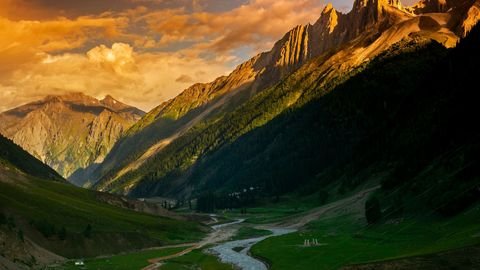
After Independence, that position grew only more important. National Highway 44 became the principal land corridor connecting the rest of India with Kashmir, while the region emerged as the logistical backbone for defence establishments, public administration and commercial supply chains serving the Valley. The Shri Mata Vaishno Devi pilgrimage expanded into one of the country’s largest religious tourism circuits, sustaining transport operators, hotels, restaurants, retailers and thousands of small businesses. Wholesale markets grew alongside the steady movement of goods, while schools, hospitals and service industries developed to meet the needs of a constantly moving economy.
None of this happened by accident, and none of it should be read as merely circumstantial. It reflected the resilience and enterprise of people who saw an opportunity and built something out of it: traders, transporters, hoteliers and professionals who walked through a door that geography had opened and did the actual work of building a livelihood on the other side of it.
But history carries a quiet warning too. Geographic advantage is rarely permanent. It shifts with technology, with new infrastructure, with changing patterns of trade. Routes that once created prosperity eventually change, distances shrink, and economic activity reorganises itself around different networks. Regions that notice this early tend to adapt and find new footing. Regions that keep leaning on yesterday’s strengths often find themselves surprised by changes that were, in hindsight, entirely predictable. That is roughly where Jammu stands today.
None of this is an argument against better connectivity, which should be welcomed without hesitation. It strengthens national integration and creates opportunity for millions. The real question is narrower: has the region actually prepared for the economic consequences of that connectivity, or has it assumed the good years would simply continue on their own? Infrastructure is an enabler. On its own, it was never a development strategy.
There’s an interesting pattern in the history of prosperous regions. The very advantage that produces growth can also delay the harder work of building something new because, when opportunity arrives naturally, there is little pressure to ask whether the conditions behind it will last. Prosperity becomes familiar, and familiarity rarely invites hard questions.
Jammu lived through a version of this. For decades, its economy moved to the rhythm of movement itself, trucks carrying supplies to the Valley, pilgrims travelling towards Vaishno Devi, government offices humming through the Darbar Move each winter, defence logistics, wholesale trade, transport and hospitality, all woven into a single working rhythm that supported thousands of families. Every journey generated demand, every stop created business, and gradually location became something close to the region’s most dependable business partner. That isn’t a weakness to apologise for. It’s a real story of a region converting its location into livelihoods, and it deserves to be told as one.
But success has its own kind of gravity. When a model keeps delivering, most energy goes into improving it rather than questioning it, and the deeper questions, the ones that seem abstract in stable times, only become urgent once circumstances start to shift. Could Jammu become a serious centre for specialised healthcare, serving not just the region but Ladakh, Himachal and parts of Punjab? Could its universities build real expertise in mountain ecology, disaster resilience or Himalayan agriculture? These were never irrelevant questions. They simply never felt urgent because the existing model kept working well enough that nobody had to answer them.
For generations, Jammu benefited from an advantage it did not have to manufacture. Its location brought trade, administration, and movement together. That inheritance served the region well. The challenge now is different. Future prosperity will depend less on where Jammu is and more on what Jammu is able to build.
This is not a uniquely Jammu problem. Ports that once dominated international trade lost ground when shipping routes changed. Railway junctions that thrived for a century saw activity drift once expressways and airports arrived. Canal towns and caravan cities across history discovered the same lesson: infrastructure has the power to redraw a region’s economic map. The places that came through it well were rarely the ones that resisted the change. They were the ones that saw it early enough to build new capability before the old advantage quietly faded. The Udhampur-Srinagar-Baramulla line belongs in that history. It isn’t a disruption of Jammu’s story so much as the opening of its next section, and what happens in that next section will depend on whether the region responds with a strategy or simply reacts as events arrive.
It is easy to mistake activity for prosperity. Busy roads, expanding markets and crowded hotels create the impression of a thriving economy, and they do sustain thousands of livelihoods. But the regions that continue to grow over decades usually have something more. They build products, knowledge and services that people come looking for, rather than simply passing through. That is the transition now confronting Jammu. Instead of asking how many more vehicles can pass through the city, the more important question is what industries can take root here. Instead of counting tourist arrivals alone, we should be thinking about how long visitors stay and what encourages them to return. The challenge is no longer simply to facilitate movement, but to create value.
Jammu already has real material to work with. Every year, patients from across the region travel to Delhi and Chandigarh for specialised care that could plausibly be built closer to home, and a serious healthcare ecosystem here wouldn’t just serve patients; it would create employment, draw skilled professionals, and pull in pharmaceutical, diagnostic and hospitality industries alongside it. Its universities could build genuine expertise around subjects that reflect where the region actually sits: mountain ecology, border management, renewable energy, Himalayan agriculture, and heritage studies, rather than competing generically with institutions elsewhere. Tourism could shift from a transit experience to a destination one, built around Dogra heritage, cuisine, wellness and the region’s own ecological range, since a visitor who stays three extra days does more for the local economy than ten who pass through in an afternoon. Logistics could grow past pure transport into warehousing, cold-chain infrastructure and food processing, positioning Jammu as a genuine link between the plains and the mountains rather than just a corridor between them.
None of that builds itself. Roads and railways connect markets, but they don’t create enterprises. That work belongs to the people willing to identify a problem and build something around it, and to the institutions and policymakers who make room for them to try. Infrastructure opens a door. What Jammu does with the space beyond it is a separate question entirely, and it’s the one that actually decides whether the coming decades feel like a period of adjustment or the start of something more confident.
There is one strength, however, that deserves to be viewed differently. Hospitals, logistics parks and industrial clusters can be created almost anywhere with enough investment and the right policy support. Duggar’s cultural inheritance cannot. Its language, the Takri script, Basohli and Pahari painting traditions, its cuisine and the historical memory of a kingdom that once stretched from the plains to the high Himalaya belong only here. They are not simply matters of preservation; they are assets that no competing region can replicate. For years, that identity has survived mostly through the effort of individuals and small community initiatives, revival projects for Takri, informal Dogri instruction, local cultural bodies working with little institutional backing, while receiving a fraction of the sustained public investment that heritage and language preservation get in states that have taken it seriously as an economic and cultural strategy rather than sentiment. Treating that identity as decoration, a footnote in a tourism brochure, is a much smaller idea than what it could actually be: the one competitive advantage in this entire discussion that no other region, however well-funded, can simply build its way into.
Every region eventually reaches a point where the question changes, from “Where are we located?” to “What are we known for?” That is the question in front of Jammu now, and the region already has the ingredients to answer it several different ways: specialised healthcare, Himalayan research, value-added logistics, knowledge-based enterprise, and an inheritance no other region can borrow or replicate. No single policy announcement or investment summit decides which of these Jammu eventually becomes. That gets settled slowly, in the accumulated choices made by universities, businesses, entrepreneurs, and government over years, not months, and there’s real reason for optimism in how that plays out. Jammu enters this transition with a strategic location, improving infrastructure, a strong trading community, real institutions and an entrepreneurial culture that has already adapted through more than one era of change. Those aren’t the traits of a region in decline. They’re the raw material of a region working out what it wants to become.
Jammu has spent generations answering the question of where it stands. The harder question, the one this transition finally forces into the open, is what it intends to become, and that answer is still being written.
Dr. Gaurav Vaid
Freelance Writer & Analyst
gauravvaid2010@gmail.com