For decades, India and Pakistan have argued over territory, borders, terrorism, and the meaning of nationhood itself. Governments changed, wars were fought, diplomatic relations rose and fell, and the rhetoric on both sides hardened with each fresh crisis. Through all of this turbulence, the rivers continued to flow. The Indus and its tributaries moved quietly through the background of South Asia’s politics, rarely commanding the kind of attention given to military deployments or diplomatic summits. Water disputes, when they arose, were settled matters for engineers and treaty experts, not front-page emergencies.
That is what makes a recent statement from Pakistan’s Prime Minister and Field Marshal worth examining beyond the immediate headlines it produced. His warning that threats to Pakistan’s water security could constitute a cause for war was not remarkable simply because it was provocative. Provocative statements are hardly rare in a region accustomed to sharp rhetoric. What makes it significant is what it reveals about a deeper transformation already underway across the world. Water, long discussed in the patient language of development and environmental policy, is entering the urgent language of national security. That shift may tell us more about the future than the statement itself.
The temptation is to read this episode purely as another chapter in the India-Pakistan story. That would be a mistake. The Indus is not simply a river system separating two nuclear-armed rivals. It is increasingly a mirror in which the twenty-first century’s most pressing anxieties are becoming visible. Across the world, governments are discovering that the gravest dangers of this era do not always arrive with armies at borders. They arrive through the systems that sustain modern life: energy grids, food supply chains, digital networks, rare minerals, and, with growing urgency, water.
For most of modern history, national security was understood in relatively direct terms. It revolved around military capability, territorial integrity, strategic alliances, and the capacity to deter adversaries. Those concerns remain essential, but they are no longer sufficient. Today’s policymakers worry not only about borders but about energy corridors, semiconductor supplies, undersea cables, and increasingly, whether rivers will continue to carry enough water to keep cities fed, powered, and politically stable. The definition of security is expanding because the nature of vulnerability has changed.
Water sits at the centre of this shift in ways that are easy to underestimate. It supports agriculture, generates electricity, sustains cities, and underpins economic activity on a scale that no other resource quite matches. When water availability becomes uncertain, the consequences do not stay in the irrigation canal or the reservoir. Food prices rise. Power generation stutters. Migration accelerates. Political grievances deepen and find new targets. What appears on the surface to be a dispute about a river often turns out, on closer inspection, to be a dispute about stability itself.
Pakistan illustrates this reality with particular clarity. The country already faces serious economic pressures, recurring energy shortages, rapid population growth, and the mounting consequences of climate vulnerability. Agriculture is heavily dependent on the Indus basin, making water not merely an environmental variable but a foundation of economic and social life. In such circumstances, anxieties about water do not exist in isolation. They amplify every other pressure already weighing on the country, which is precisely why threats to the river system carry such explosive political weight. A farmer watching his fields dry up is not having an environmental debate. He is watching his livelihood disappear, and he knows who to blame.
The situation becomes more complex still when viewed alongside the unrest that has periodically surfaced in parts of Pakistan-administered Kashmir and Gilgit-Baltistan. The grievances there are rooted in questions of governance, development, resource distribution, and political representation, with their own specific local causes. But they also reflect something broader. Across many parts of the world, communities are demanding greater participation in decisions that affect their resources and their futures. When economic stress, governance deficits, and resource pressures converge in the same geography, even technical questions about water management can become flashpoints of strategic consequence.
None of this is uniquely Pakistani. The pressures surrounding freshwater are becoming global, and rivers are everywhere becoming the site where larger tensions are worked out. Along the Nile, Ethiopia’s Grand Renaissance Dam has drawn Egypt into direct confrontation with a neighbour it cannot afford to ignore, raising concerns that go far beyond hydroelectricity into existential questions of food security for one of the world’s most populous nations. In the Middle East, the Euphrates and Tigris systems have been squeezed by a combination of upstream dams, political fragmentation, and worsening drought, with consequences that have played out in agricultural collapse, displacement, and political instability across the region. Across Southeast Asia, debates surrounding the Mekong extend into fisheries, food production, and the strategic ambitions of the nations competing to shape its future.
In each case, the river is real, the water is real, and the thirst is real. But the tensions reveal something larger than hydrology. They expose the accumulated pressures that societies are already struggling to manage, and the water becomes the surface on which those pressures become legible.
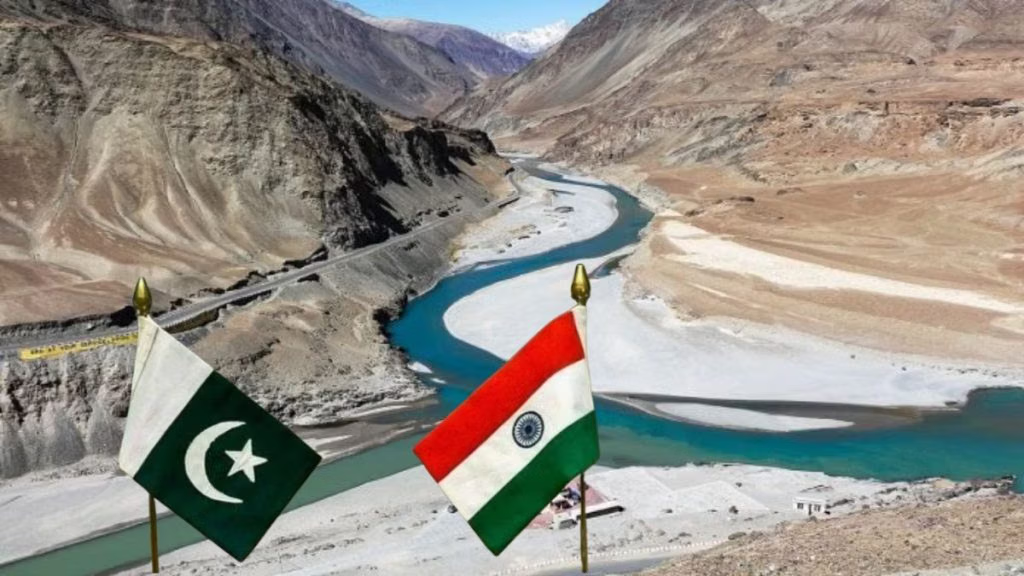
This is why predictions about future “water wars” are often misguided, even when they contain a grain of truth. Nations rarely go to war over a single cause, and rivers alone do not start conflicts. War emerges when multiple stresses begin reinforcing one another, when economic instability, political grievance, demographic pressure, environmental disruption, and institutional failure converge in ways that narrow the space for peaceful resolution. Water becomes dangerous not because it directly causes conflict but because it is woven through so many of the systems on which modern life depends. When those systems begin to fray, water is often the thread that unravels first.
The Indus basin makes this particularly visible. When the Indus Waters Treaty was negotiated more than six decades ago, the strategic environment was radically different. Populations were smaller. Climate science was in its infancy. Urbanisation had not reached its current scale, and the pressures of modern food production, industrial growth, and energy demand were far less intense. The river is the same, but the world drawing from it has been transformed. A treaty designed for one era is increasingly being tested by the conditions of another.
This tension between old frameworks and new realities is not unique to the subcontinent. Across the world, policymakers are discovering that the agreements, institutions, and assumptions that governed resource management for decades are straining under the weight of climate change, population growth, and geopolitical competition. Glaciers that feed major river systems are retreating. Rainfall patterns are shifting in ways that render historical averages unreliable. Extreme weather events are occurring with a frequency that no infrastructure was originally designed to absorb. Governments are being forced to think about resources not merely as things to be divided and managed but as things whose long-term availability can no longer be assumed.
India faces its own version of these pressures. As a growing economy with expanding cities, rising energy demands, and an agricultural sector that continues to employ hundreds of millions, water management is no longer a technocratic footnote to development policy. It is becoming a central strategic challenge. The difficulty is that it cannot be managed in isolation. It intersects with environmental stewardship, infrastructure investment, interstate relations within the country, and the management of relationships with neighbours who share the same watersheds. There is no clean solution, only a set of choices about how to balance competing claims on a resource that is becoming scarcer and less predictable.
The broader point is that the nature of strategic competition itself is changing. For generations, geopolitics was visualised through maps of borders, military deployments, and territorial control. Those maps still matter, but they are now overlaid by another kind of geography entirely, one defined by systems rather than territories. Nations increasingly think in terms of energy corridors, digital infrastructure, shipping lanes, rare earth supply chains, and freshwater because these systems determine how resilient a society remains when it comes under pressure from without or within. Control a border and you control a line. Control a system, and you control the conditions of life.
Recent history has driven this lesson home in ways that were not easily ignored. Disruptions to shipping routes have rippled through global trade. Energy shocks have destabilised domestic politics far from their point of origin. Semiconductor shortages have exposed how dependent advanced economies are on narrow, fragile supply chains. What once seemed like specialised economic concerns turned out to be matters of national survival. Water is now entering that same category, and it is doing so not gradually but with the speed that climate and demographic pressure together demand.
This does not mean that rivers are destined to become battlefields. History frequently shows the opposite. Shared resources can create genuine incentives for cooperation even among rivals, and some of the most durable diplomatic arrangements in the world have been built around the management of common waters. The challenge is whether institutions, policies, and political will can evolve quickly enough to stay ahead of the pressures that are accumulating. The future depends not only on how resources are divided but on whether societies can build the trust and the mechanisms to adapt together rather than collide.
The significance of the Indus, then, lies not in any single statement or diplomatic crisis. It lies in what the river has come to represent. A waterway that once stood as a rare example of functional cooperation between two otherwise hostile states now increasingly reflects the anxieties of an era defined by interconnected risks. The conversation surrounding it is no longer confined to hydrology or treaty law. It has become part of a larger, unresolved debate about how nations secure their future when the threats are not armies on frontiers but pressures embedded in the very systems that keep societies functioning.
When water enters the language of security, it signals something more than anxiety about a river. It signals a recognition, still imperfect and often reluctant, that the pressures shaping this century are deeply entangled. Climate, economics, governance, demographics, and national security no longer inhabit separate policy silos. They bleed into one another, and water is one of the places where that bleeding becomes impossible to ignore.
The river between rivals is still flowing. The question is not whether the water will continue its journey. The question is whether nations will choose to see that river as a shared responsibility or as a weapon waiting to be wielded. How they answer that question will reveal far more than the fate of one treaty or one relationship. It may offer the clearest glimpse we have of how the world intends to navigate an age in which the most consequential contests are not fought at borders but fought over the systems that make life possible at all.
Dr. Gaurav Vaid
Freelance Writer & Analyst
gauravvaid2010@gmail.com
Source: https://greaterjammu.com/epaper/epaper/edition/1009/-epaper25-6-2026/page/6